• News
    • News & Views
    • RGME Activities for 2024 and 2025
    • Around & About with the RGME
    • Reviews
    • Highlights
  • Blogs
    • Manuscript Studies
      • Manuscript Studies: Contents List
    • International Congress on Medieval Studies
      • Abstracts of Congress Papers
        • Abstracts of Papers Listed by Author
        • Abstracts of Papers Listed by Year
  • About
    • Mission
    • Who We Are
      • Officers, Associates & Volunteers
      • RGME Committees
      • Friends of the Research Group on Manuscript Evidence
    • Policies & Statements
      • RGME Privacy Policy Statement
      • RGME Intellectual Property Statement & Agreements
    • People
      • Mildred Budny — Her Page
      • Adelaide Bennett Hagens
    • Activities
      • Events
      • Congress Activities
        • Sponsored Conference Sessions (1993‒)
          • Panels at the M-MLA Convention (from 2016)
        • Co-sponsored Conference Sessions (2006‒)
    • History
      • Seals, Matrices & Documents
      • Genealogies & Archives
    • Contact Us
  • Bembino
    • Multi-Lingual Bembino
    • RGME Bembino: Resources
  • Congress
    • Sponsored Conference Sessions (1993‒)
    • Co-sponsored Conference Sessions (2006‒)
    • Abstracts of Congress Papers
      • Abstracts Listed by Author
      • Abstracts Listed by Year
    • Kalamazoo Archive
    • Panels at the M-MLA Convention (2016-2019)
      • Abstracts of Papers for the M-MLA Convention
      • Panels at the M-MLA Convention (from 2016)
  • Events
    • RGME Activities for 2024 and 2025
      • 2023 Activities and 2024 Planned Activities
    • Seminars, Workshops, Colloquia & Symposia (1989–)
      • Seminars on ‘The Evidence of Manuscripts’
      • Symposia on ‘The Transmission of the Bible’
      • The New Series (2001-)
        • 2019 Anniversary Symposium Program: The Roads Taken
        • 2019 Anniversary Symposium Registration
        • 2019 Anniversary Symposium Registration Open
      • RGME Symposia: The Various Series
      • The Research Group Speaks: The Series
      • Meetings of the Friends of the Research Group on Manuscript Evidence
      • RGME Online Events
    • Abstracts of Papers for Events
      • Abstracts of Papers for Seminars on ‘The Evidence of Manuscripts’
      • Abstracts of Papers for Symposia, Workshops & Colloquia
    • Receptions & Parties
    • Business Meetings
    • Photographic Exhibitions & Master Classes
    • Events Archive
  • ShelfLife
    • Journal Description
    • ShelfMarks: The RGME-Newsletter
    • Publications
      • “Insular, Anglo-Saxon, and Early Anglo-Norman Manuscript Art at Corpus Christi College, Cambridge” (1997)
        • Mildred Budny, ‘Catalogue’
        • The Illustrated Catalogue (1997)
      • The Illustrated Handlist
      • Semi-Official Counterfeiting in France 1380-1422
      • No Snap Decisions: Challenges of Manuscript Photography
    • History and Design of Our Website
  • Galleries
    • Watermarks & the History of Paper
    • Galleries: Contents List
    • Scripts on Parade
    • Texts on Parade
      • Latin Documents & Cartularies
      • New Testament Leaves in Old Armenian
    • Posters on Display
    • Layout Designs
  • Donations and Contributions
    • RGME Donor Promise
    • 2023 End-of-Year Fundraiser for our 2024 Anniversary Year
    • 2019 Anniversary Appeal
    • Orders
  • Links
    • Catalogs, Metadata, and Databases: A Handlist of Links
    • Handlist of Resources for Manuscript Studies and Fragmentology
    • Manuscripts & Rare Books
    • Maps, Plans & Drawings
    • Seals, Seal-Matrices & Documents

  • News
    • News & Views
    • RGME Activities for 2024 and 2025
    • Around & About with the RGME
    • Reviews
    • Highlights
  • Blogs
    • Manuscript Studies
      • Manuscript Studies: Contents List
    • International Congress on Medieval Studies
      • Abstracts of Congress Papers
        • Abstracts of Papers Listed by Author
        • Abstracts of Papers Listed by Year
  • About
    • Mission
    • Who We Are
      • Officers, Associates & Volunteers
      • RGME Committees
      • Friends of the Research Group on Manuscript Evidence
    • Policies & Statements
      • RGME Privacy Policy Statement
      • RGME Intellectual Property Statement & Agreements
    • People
      • Mildred Budny — Her Page
      • Adelaide Bennett Hagens
    • Activities
      • Events
      • Congress Activities
        • Sponsored Conference Sessions (1993‒)
          • Panels at the M-MLA Convention (from 2016)
        • Co-sponsored Conference Sessions (2006‒)
    • History
      • Seals, Matrices & Documents
      • Genealogies & Archives
    • Contact Us
  • Bembino
    • Multi-Lingual Bembino
    • RGME Bembino: Resources
  • Congress
    • Sponsored Conference Sessions (1993‒)
    • Co-sponsored Conference Sessions (2006‒)
    • Abstracts of Congress Papers
      • Abstracts Listed by Author
      • Abstracts Listed by Year
    • Kalamazoo Archive
    • Panels at the M-MLA Convention (2016-2019)
      • Abstracts of Papers for the M-MLA Convention
      • Panels at the M-MLA Convention (from 2016)
  • Events
    • RGME Activities for 2024 and 2025
      • 2023 Activities and 2024 Planned Activities
    • Seminars, Workshops, Colloquia & Symposia (1989–)
      • Seminars on ‘The Evidence of Manuscripts’
      • Symposia on ‘The Transmission of the Bible’
      • The New Series (2001-)
        • 2019 Anniversary Symposium Program: The Roads Taken
        • 2019 Anniversary Symposium Registration
        • 2019 Anniversary Symposium Registration Open
      • RGME Symposia: The Various Series
      • The Research Group Speaks: The Series
      • Meetings of the Friends of the Research Group on Manuscript Evidence
      • RGME Online Events
    • Abstracts of Papers for Events
      • Abstracts of Papers for Seminars on ‘The Evidence of Manuscripts’
      • Abstracts of Papers for Symposia, Workshops & Colloquia
    • Receptions & Parties
    • Business Meetings
    • Photographic Exhibitions & Master Classes
    • Events Archive
  • ShelfLife
    • Journal Description
    • ShelfMarks: The RGME-Newsletter
    • Publications
      • “Insular, Anglo-Saxon, and Early Anglo-Norman Manuscript Art at Corpus Christi College, Cambridge” (1997)
        • Mildred Budny, ‘Catalogue’
        • The Illustrated Catalogue (1997)
      • The Illustrated Handlist
      • Semi-Official Counterfeiting in France 1380-1422
      • No Snap Decisions: Challenges of Manuscript Photography
    • History and Design of Our Website
  • Galleries
    • Watermarks & the History of Paper
    • Galleries: Contents List
    • Scripts on Parade
    • Texts on Parade
      • Latin Documents & Cartularies
      • New Testament Leaves in Old Armenian
    • Posters on Display
    • Layout Designs
  • Donations and Contributions
    • RGME Donor Promise
    • 2023 End-of-Year Fundraiser for our 2024 Anniversary Year
    • 2019 Anniversary Appeal
    • Orders
  • Links
    • Catalogs, Metadata, and Databases: A Handlist of Links
    • Handlist of Resources for Manuscript Studies and Fragmentology
    • Manuscripts & Rare Books
    • Maps, Plans & Drawings
    • Seals, Seal-Matrices & Documents

Log in

Archives

Featured Posts

2026 International Congress on Medieval Studies: Program
Episode 24. “Life with Books” (Interview with John Windle)
Announcing the Launch of RGME Bembino WP
2026 RGME Colloquium at The Grolier Club: Report
Medieval Missal Fragment as Early-Modern Cover
The Weber Leaf from Ege MS 61
"Bembino" Booklet Cover
Episode 23. “Meet RGME Bembino: Facets of a Font”
2026 RGME Colloquium on “Transformations & Renewals” at The Grolier Club
2026 Theme of the Year: “Transformations and Renewals”
A Leaf with Patchwork from the Saint Albans Bible
A Sister Leaf from a Miniature Latin Vulgate Bible
A Little Latin Vulgate Bible Manuscript Leaf in Princeton
J. S. Wagner Collection. Leaf from from Prime in a Latin manuscript Breviary. Folio 4 Verso, with part of Psalm 117 (118) in the Vulgate Version, set out in verses with decorated initials.
2026 Annual Appeal
Episode 22: “Encounters with Local Saints and Their Cults”
Private Collection, Ege's FBNC Portfolio, Dante Leaf, Verso, Detail. Reproduced by Permission.
2025 RGME Autumn Colloquium on Fragments
Workshop 8: A Hybrid Book where Medieval Music Meets Early-Modern Herbal
2025 RGME Autumn Symposium on “Readers, Fakers, and Re-Creators of Books”
RGME Workshops on “The Evidence of Manuscripts, Etc.”
2025 International Medieval Congress at Leeds: RGME Program
Episode 21. “Learning How to Look”
2025 International Congress on Medieval Studies: Program
2025 RGME Visit to Vassar College
Two Leaves in the Book of Numbers from the Chudleigh Bible
Delibovi on Glassgold on Boethius: A Blogpost
Ronald Smeltzer on “Émilie du Châtelet, Woman of Science”
2025 Spring Symposium: “Makers, Producers, and Collectors of Books”
Starters’ Orders
The Weber Leaf from the Saint Albans Bible
Workshop 4. “Manuscript Fragments Compared”
Episode 20. “Comic Book Theory for Medievalists”
Episode 19: “At the Gate: Starting the Year 2025 at its Threshold”
Favorite Recipes for Lemonade, Etc.
RGME Visit to the Lomazow Collection: Report
2024 Autumn Symposium: “At the Helm”
A Latin Vulgate Leaf of the Book of Numbers
The RGME ‘Lending Library’
Florence, Italy, Ponte Vecchio from Ponte alle Grazie. Photo: Ingo Mehling, CC BY-SA 4.0 , via Wikimedia Commons
Episode 17. “RGME Retrospect and Prospects: Anniversary Reflections”
2024 Anniversary Symposium: The Booklet
Jesse Hurlbut at the Bonneville Salt Flats, Utah. Photograph Jesse Hurlbut.
Episode 16: An Interview with Jesse D. Hurlbut
To Whom Do Manuscripts Belong?
Kalamazoo, MI Western Michigan University, Valley III from the side. Photograph: David W. Sorenson.
2024 International Congress on Medieval Studies: Report
2024 Spring Symposium at Vassar College
Puente de San Martín: Bridge with reflection over the River Targus, Toledo, Spain.
2024 Grant for “Between Past and Future” Project from The Gladys Krieble Delmas Foundation Research Libraries Program
2024 Anniversary Symposium in Thanks to Jesse Hurlbut: Program

You are browsing the Blog for Gothic Manuscripts

Leaf from a Tiny Book of Hours

October 22, 2015 in Manuscript Studies, Photographic Exhibition

Leaf Within the Hours of the Virgin
From an Unknown Manuscript

Detached Vellum Leaf
Circa 76 × 54 mm < written area circa 40 × 36 mm >
Single column of 12 lines in Latin in Gothic rotunda script, with polychrome embellishments

Budny Handlist 11
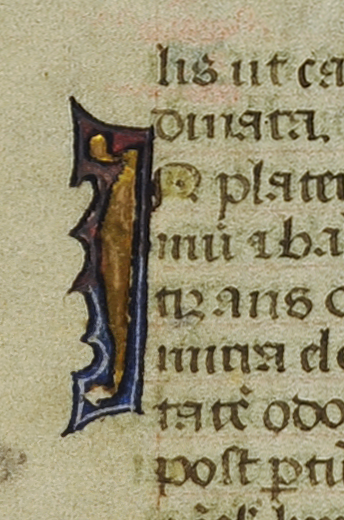
Detail of Verso from a Detached Leaf from a tiny Book of Hours, with the decorated initial I of 'In' within the Hours of the Virgin. Photography © Mildred BudnyIn our series on Manuscript Studies, Mildred Budny reports on items in the Illustrated Handlist, among other specimens.

Usually those items have some evidence, internal and/or contextual, which enable or imply the identifications of their places or regions of origin, the original manuscripts to which the dispersed fragment belongs, and/or their routes of transmission to the current owner.  Various of our blogposts in the series prove these possibilities.  Not in this case.

Here we focus on a fragment of a tiny Book of Hours which strayed into the group without any record of its provenance. We illustrate this fragment as an opportunity for recognition among its peers.

In Perspective

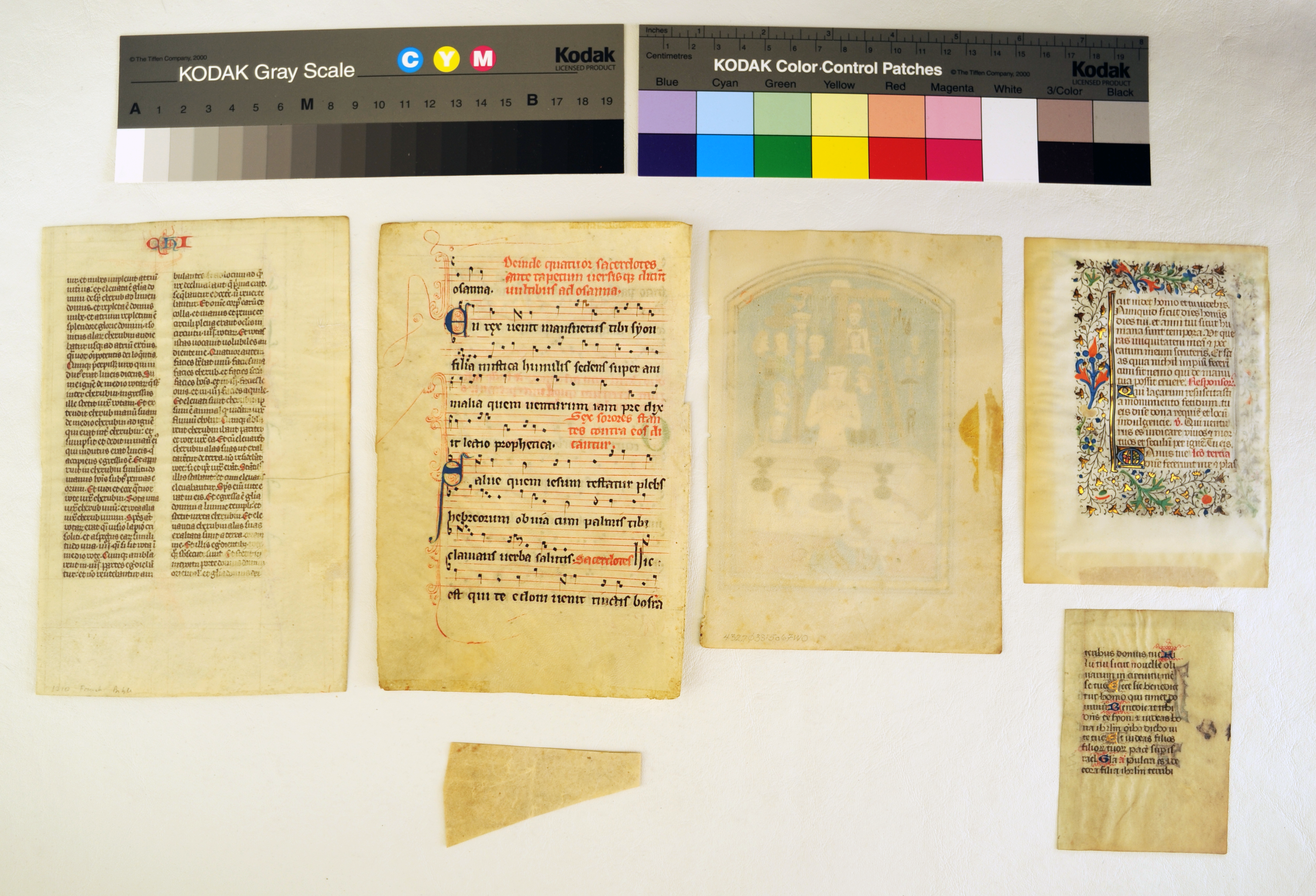
The scale of this leaf leaf comes into perspective when set among some of its companions in the Handlist.  As in the set of Group Portraits, front and back. The Leaf had its debut among our Manuscript Groupies.

Within those collective Photo Opportunities, Views 1 and 2, this Leaf appears at bottom right, respectively with its Verso and Recto.
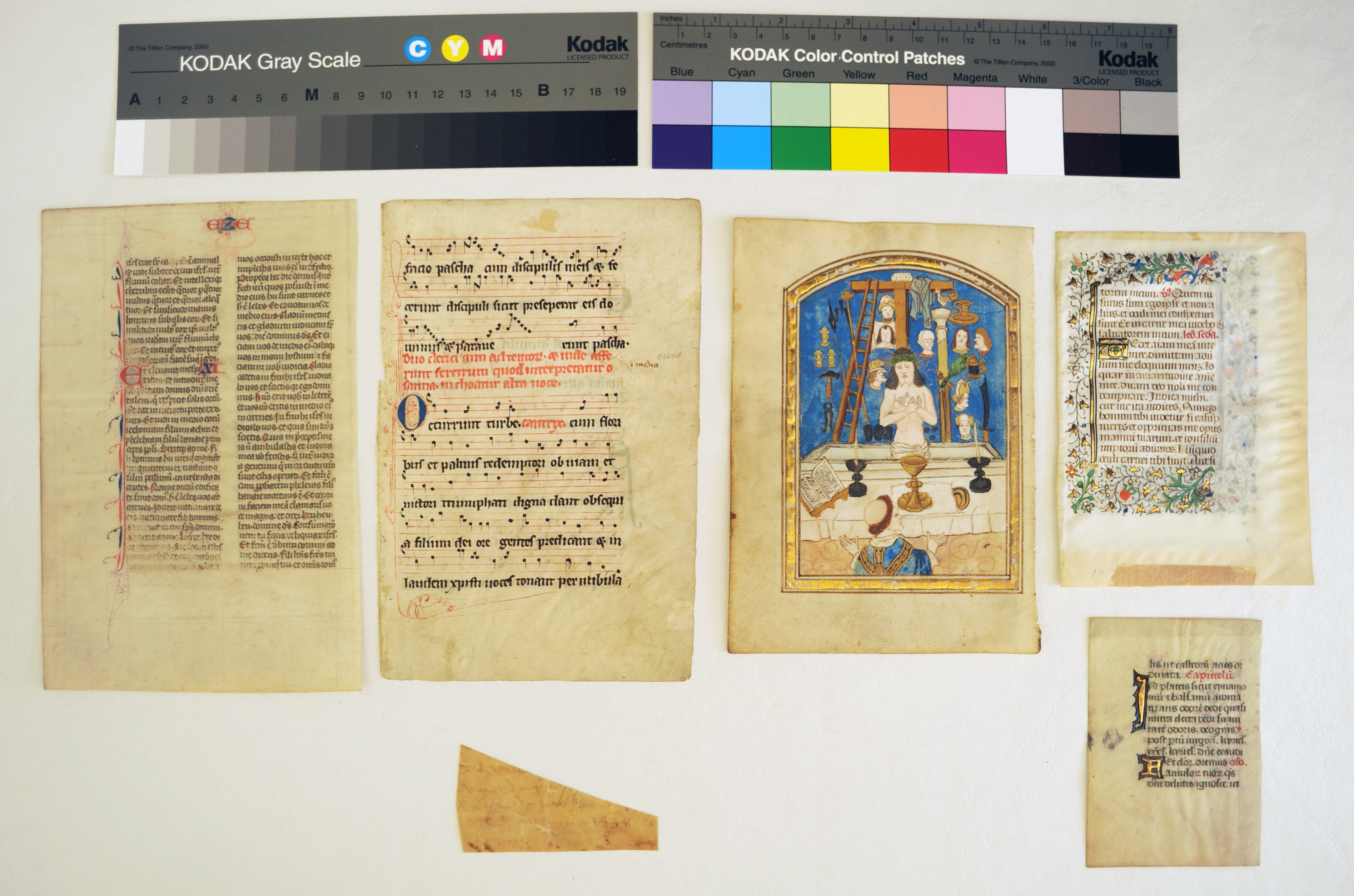
6 leaves in the 'Handlist', shown variously in their rectos or versos, by chance as the occasion arose. Photography by Mildred Budny

Group Portrait View 1

6 leaves in the 'Handlist', shown variously in their versos or rectos, by chance as the occasion arose. Photography by Mildred Budny

Group Portrait, View 2


Tiny, right?  A lovely shape to clasp in the hand.  The original manuscript must have been a joy to hold and to behold.

Text and Context
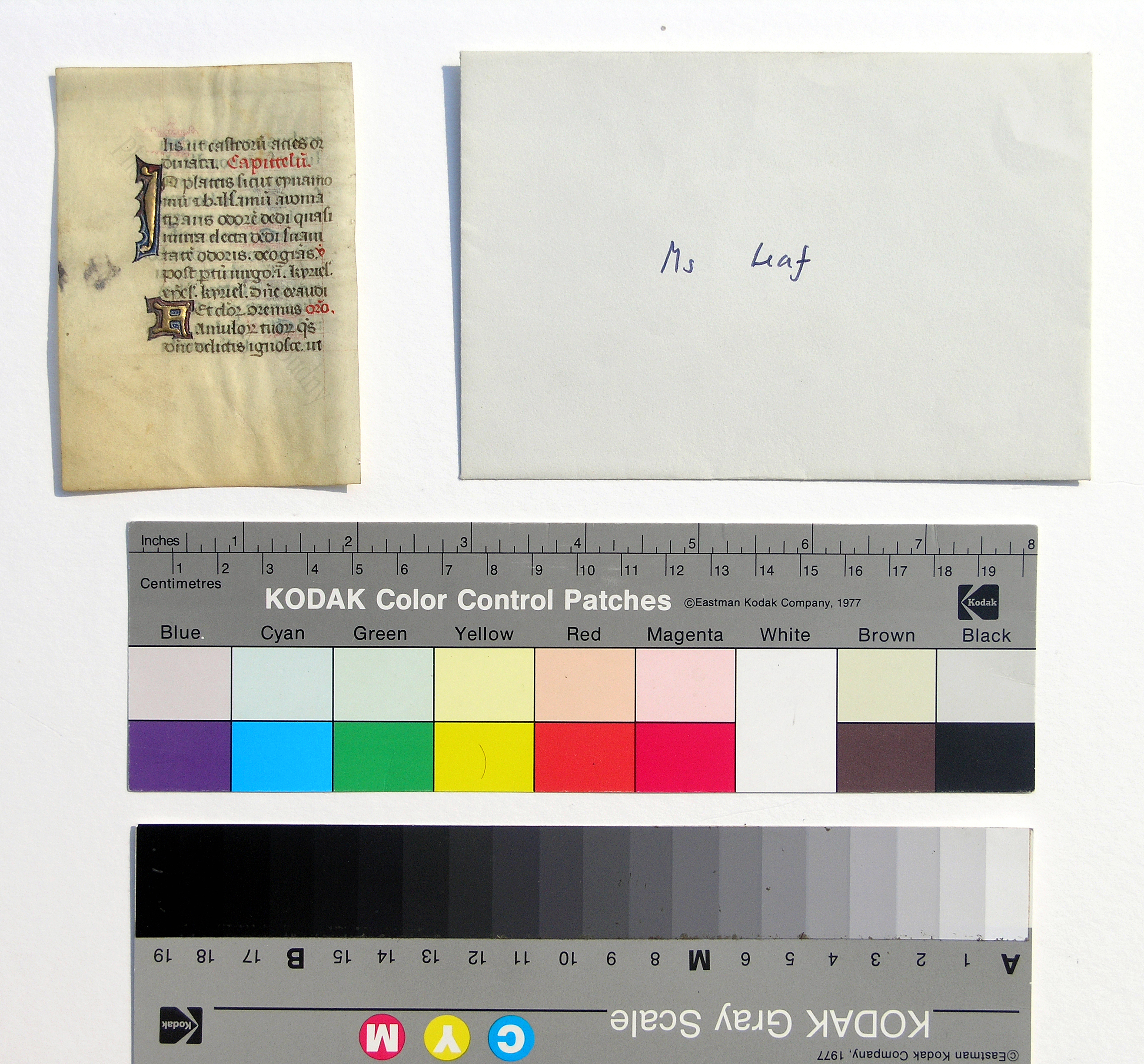
The Leaf, turned to the Verso, alongside the small-format envelope used to 'contain' the leaf, shown from its front with the owner's handwritten inscription in blue ink 'Ms leaf', as well as a color guide and scale for reference. Reproduced by permission of the photographer.The thin Leaf turns its yellowed hairside of the animal skin toward the recto, and the whitish fleshside to the verso.  An unevenly undulating cut severed the leaf from its former conjoint stub or, more probably, conjoint leaf of a bifolium, with some traces remaining along the inner margin of marks for the former stitching of the volume.  The marks of dirt accumulated along the upper, lower, and outer edges attest to a period of storage as a closed volume.

The smudged, darkened stain aligned about midway down the outer edge probably derives from contact with a metal clasp oxidized over time.  Such a closure would have helped to embrace firmly a small, fat volume of the sort which a full Book of Hours in such a compact layout would have required.

At present, the leaf measures circa 76 × 54 mm, with a written area of circa 40 × 36 mm.  The single column of 12 lines is written in Latin in Gothic rotunda script, with embellishments.  Although somewhat perfunctory in the execution, the embellishments and their colorful materials add an element of luxury.
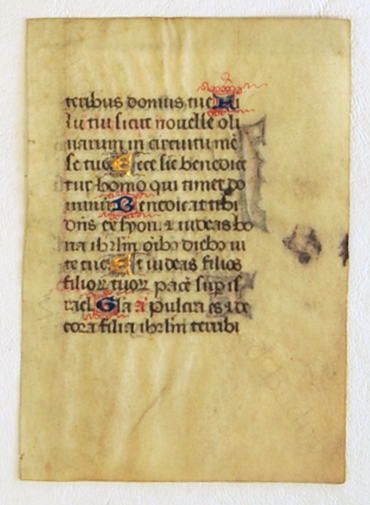
Recto of leaf from a tiny 12-line Book of Hours, with in-line initials decorated with red pen-flourishing. Budny Handlist 11. Photograph © Mildred Budny

Recto

The embellishments include rubricated titles, in-line initials with pen-flourishes, and enlarged polychrome initials with ornamental frames.  On the recto, the 1-line initials for sections beginning within the lines are alternately blue and gold respectively with red or purple penline extensions comprised mainly of undulating lines resembling pulled sugar ripples.
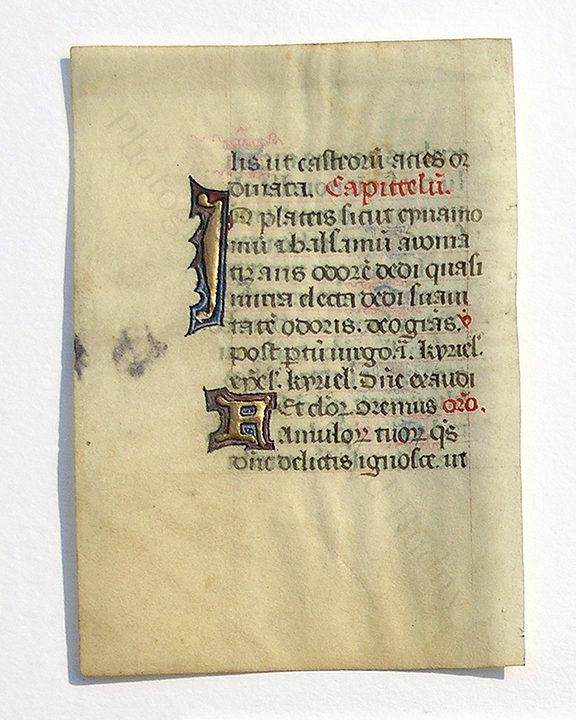
Recto of leaf from a tiny 12-line Book of Hours, with 2 polychrome opening initials in gold leaf and other pigments Budny Handlist 11. Photograph © Mildred Budny

Verso

On the verso, the polychrome decorated initials either stand alongside the column on the verso (6-line-high I for In of the Capitulum, that is, ‘Reading’, from the Old Testament Book of Ecclesiasticus) or occupy a position inset within it (2-line-high F for Famulorum of the Oratio or ‘Prayer’).  For these enlarged initials, the letter itself is rendered in gold leaf, with bulbous tips, against an asymmetrical background frame with toothed or cusped edges and extended tips.  Each frame, filled with sections of rusty reddish and blue pigments, has an inset inner contour of white pigment.  Within the F, the 2 enclosed counters above and below its tongue have a surcharged pattern of white dots.

The Text

The text on the leaf both starts and ends mid-phrase.  It extends from within:

Psalm 127:3 ([la-/]teribus . . . Israel)

to within:

Prayer: Famulorum tuorum . . . ut [/ qui] .

The text corresponds mostly to a portion of the Hours of the Virgin represented in a paragdigm online here (with an English translation), where the assigned location within the Hours (in that case, for the Use of Rome) is None, that is, the mid-afternoon prayer within the canonical periods for daily prayer.  Expanding the abbreviations in the text, the transcription here of the Leaf provides points of orientation as well as indications of its divergences from the paragdigm.

The preceding leaf apparently ended within Psalm 127:3

[3 Uxor tua sicut uitis abundans. in la-/]

[RECTO]

teribus domus tue Fi[-]
lii tui sicut nouclle [? sic for germina] oli[-]
arum in circuitu men[-]
se tue [4] Ecce sicut benedice[-]
tur homo [<uiro] qui timet do[-]
minum [5] Benedicat tibi
dominus ex syon et uideas bo[-]
na iherusalem omnibus diebus ui[-]
te tue [6] Et uideas filios
filiorum tuorum pacem super is[-]
rael Gloria A[ntiphon] pulcra es et de[-]
cora filia iherusalem terribi[-]

[RECTO] / [VERSO]

lis ut castrorum acies or[-]
dinata. Capittlu[m] [sic; = Ecclesiasticus 24:19–20].
In plateis sicut cynamo[-]
mum et balsamum arom[-]
tizans odorem dedi quasi
mirra decta electi dedi suaui[-]
atem odoris. deo gratias. V[ersiculus]
post partum uirgo. et. kyrie eleison
christe eleison. kyrie eleison. domine exaudi
et clamor. oremus Or[ati]o.
Famulorum tuorum quos
domine delictis ignosce. ut

[VERSO] / [qui tibi pacu . . . ]

The next leaf would have picked up from there.

Such a span of text occurs within various Books of Hours, and for various points within the Hours. The use of the Antiphon Pulchra es et decora filia Jerusalem terribilis ut castrorum acies ordinata is recorded in a variety of sources for several occasions within the liturgical year.

Therefore, without fuller knowledge about the other parts of the original manuscript and its specific approaches, it seems difficult to determine to which place within the Hours the portion represented by this leaf would have specifically corresponded.

Without better evidence, we resist a temptation to assign this very reading in this specific manuscript to a particular part of the Office of the Virgin.

About that Manuscript

Haven’t identified it yet.

You may remember that some of our blogposts in the series on Manuscript Studies have identified fragments from manuscripts dispersed by Otto F. Ege (among others). So far, these have addressed ‘Ege Manuscripts’ 8, 14, 41, and 61.  So the nature of his dispersals and the resources for identifying some of them have become familiar.  You can find descriptions and references in those posts.

Scott Gwara’s Handlist (2013) of ‘Manuscripts Collected or Sold by Otto F. Ege’ does not apparently include any volume which corresponds neatly to the characteristics of this leaf. We were hopeful.

A somewhat similar manuscript, fragmented and dispersed, is represented in Ege’s Portfolio of Fifty Original Leaves from Medieval Manuscripts, Number 36, a mid-15th-century French Book of Hours with a (not identical) comparable style, layout, and decoration.  But it has 13 lines per column, rather than the 12 on this Leaf, and includes some other approaches to decoration, such as interlace patterns and the use of double (rather than single) white outlines inside the frames for initials.

Date and Origin?

Wish we knew.  Suffice, perhaps, for now, to say that the rotunda script indicates an ‘Italianate’ element.  Not that this means that it is Italian script, or the work of an Italian scribe.  Just an element, important to register.

However, the style of the initials seems French instead.

Interesting combination of influences.

So, perhaps, this leaf and its original manuscript (if fully consistent) might have originated in Southern France, Italy, or (say) Spain, circa 1400 or later.

Transmission?  Forget It!

The owner reports, in responses to questions repeated over years, that this leaf was acquired at an unknown date, unframed, and from an unremembered source.  He confirms that the single-line inscription in ink on the envelope is his own handwriting.

It was probably a gift, but not sufficiently memorable as such, unlike another leaf from a different Book of Hours (Handlist 12) acquired as a wedding present.  It was presumably a gift, he observes, because its purchase is neither remembered nor recorded among the available papers.

So much for continuity.

Shucks

On a personal note.  Usually I am reluctant to say such.

Collectors Gonna Do Whatever.  Right.  They can.

But this situation makes me wonder.  I remember vividly, clearly, precisely, the gifts, and their circumstances, which ever I have received.  When I see — of course, because I place them in view — any gift, you know, I smile with recognition of the person, place and time of presentation (by whatever means, near or far), and even I the recall of the light or sunlight of the reception.  That is how I think, and remember.  Sensitive Creature, that’s me.
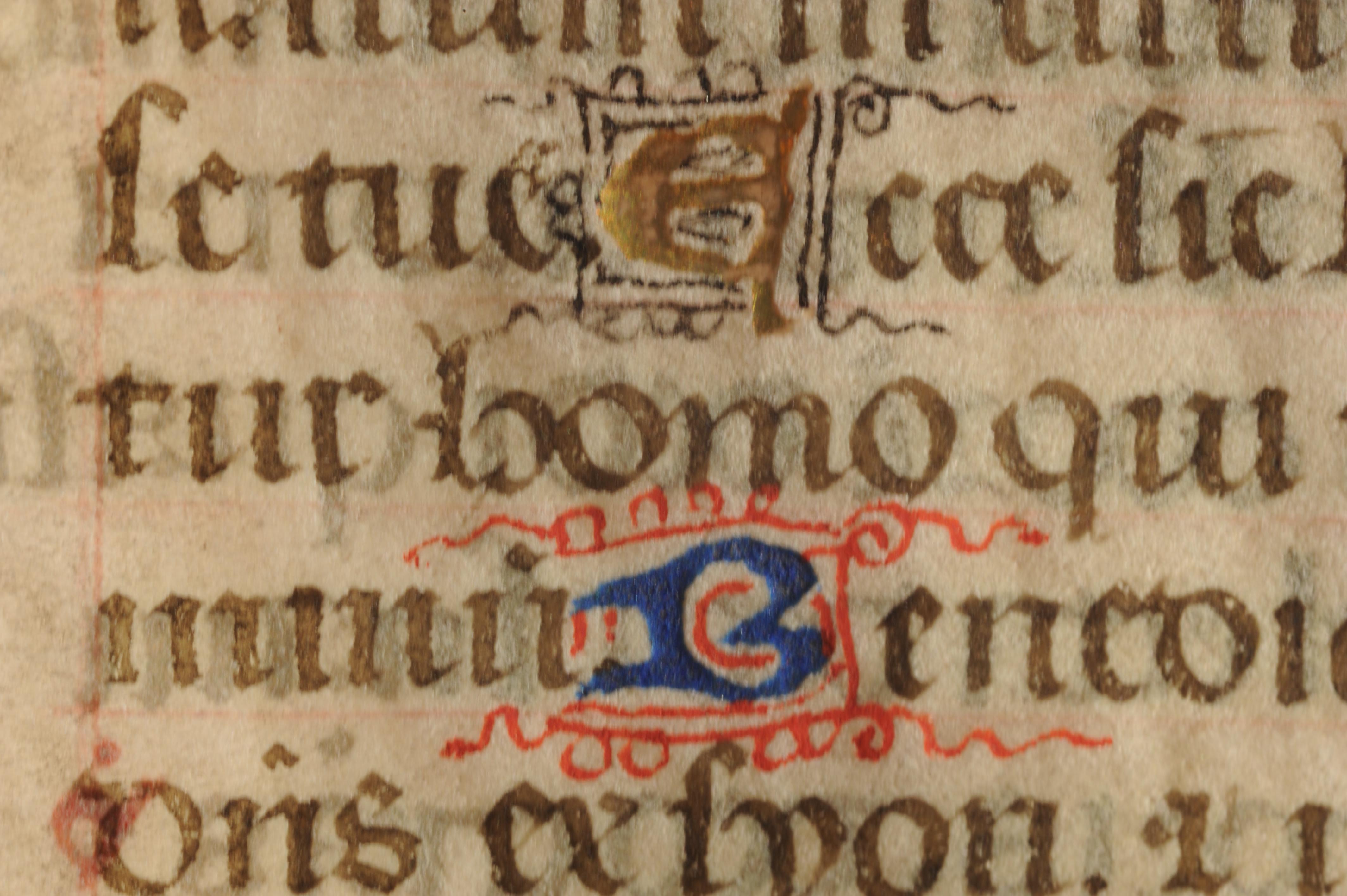
Detail of Recto of the leaf from a tiny Book of Hours, with 2 1-line in-line initials respectively in Gold or Blue pigment with pen-flourishes respectively of purple or red pigment. Photography © Mildred BudnyAnd so, this occasion with the necessity to encounter forgetfulness, amounting apparently to negligence or indifference (same difference), makes me wonder differently, and with increased appreciation, about the merits of Eastern habits of stamping materials in the stages of successive ownership and appreciation.  It seems a method worth considering for Western Stuff.

Seems more respectful.  I aim to label gifts to me even more precisely than before.

P. S.  You hear that?  I am the sort of person who appreciates gifts.

Hint?  You think?

Over to You

Do you know of any other leaves from this tiny book?  They could be anywhere.

******

We thank the owner of the leaf for permission to photograph, research, and publish it.  It is a pleasure also to record thanks to Adelaide Bennett, Gregory Clark, and James Marrow for their expert advice about the leaf.

*****


Tags: Book of Hours, Gothic Manuscripts, Otto Ege's Manuscripts
No Comments »

A New Leaf from ‘Otto Ege Manuscript 14’

September 6, 2015 in Manuscript Studies, Photographic Exhibition

Part of the ‘Interpretation of Hebrew Names’
from a 50-line Lectern Bible
in the Vulgate Version

Budny, Handlist Number 9
A Leaf From ‘Otto Ege Manuscript 14’

Alcath – Ananias in the A-Group
From the Interpretationes Hebraicorum Nominum
In the partly alphabetized Version beginning Aaz Apprehendens (or a Variant thereof)
At the end of a large-format Bible used for lectern reading

Circa 312 × 212 mm <written area circa 225 × 157 mm >
Triple Columns of 50 lines written in Gothic Formata bookhand
Produced probably in Flanders or Northern France, circa 1325

In our series on Manuscript Fragments, Mildred Budny examines some leaves dispersed into various collections, both private and public, through the methods of Otto F. Ege. Earlier posts on those leaves considered Lost and Foundlings, A New Leaf from ‘Otto Ege Manuscript 41’, and A New Leaf from ‘Otto Ege Manuscript 8’.  Later posts considered A New Leaf from ‘Otto Ege Manuscript 61’ and New Leaves from ‘Otto Ege Manuscript 51’.

Now we focus on a large-format leaf which, despite its relatively unembellished contents, formerly belonged to a large-format single-volume Bible amply endowed with decoration, illustrations, and glittering gold.

Read the rest of this entry →

Tags: 'Aaz-Apprehendens' Version, Beinecke Rare Book and Manuscript Library, Bible Manuscripts, Budny Handlist, Gothic Manuscripts, Interpretationes Hebraicorum Nominum, Lectern Bible, Otto Ege Manuscript 14, Otto Ege's Manuscripts, Parke Bernet Galleries, Sothebys
1 Comment »

  • Top
©2024 Research Group on Manuscript Evidence.


is proudly powered by WordPress. WordPress Themes X2 developed by ThemeKraft.