
2026 International Medieval Congress at Leeds: Program
July 1, 2026 in Announcements, Conference, Conference Announcement, International Medieval Congress, Manuscript Studies
“Manuscripts at Play and as Play:
Temporalities and (Re)Configurations
as Reading Methods”
Session Sponsored
by the Research Group on Manuscript Evidence
at the 2026 International Medieval Congress
(In person or Hybrid)
6–9 July 2026
Organisers:
Michael Allman Conrad
and Mildred Budny
Session 609
Tuesday, 7 July 2026
11:15 am –12:45 pm British Summer Time (= GMT+1)
Hybrid:
Laidlaw Library, Teaching Room 2
and online for Congress Registrants
The Name of the Game
For 2026 the RGME proposes to explore the nature of play in manuscripts across time and place. We think of manuscripts at play, as play, and in play.
With the success of our activities at the International Medieval Congress (IMC) at Leeds in 2024 and 2025, we prepare for another year responding to the “Special Thematic Strand” selected for the 2026 IMC:
Our choice of session addresses
“Manuscripts at Play and as Play:
Temporalities and (Re)Configurations
as Reading Methods”
After announcing and successfully completing our 2026 Call for Papers, we selected the programme for our session, announced here and in the
- 2026 IMC Programme (page 160).
For information about the IMC:
- International Medieval Congress at Leeds
- 2026 IMC Programme
- Call for Papers for the 2026 IMC, with the Special Thematic Strand of “Temporalities”.
- IMC 2026 Padlet, with poster-like announcements of Calls for Papers
The Plan:
Locating Manuscripts in Their (Mobile) Temporalities
For the 2026 IMC and its Special Theme, we explore manuscripts in terms of the essence of their ‘temporalities’ (also see Temporalities) — that is, in a nutshell, “the state of existing within or having some relationship with time”, which pertains intrinsically to any physical object, just like its “spatial position”. That essence or condition, combining location with points in time, forms both centerpiece and focus-point going forward in our continuing studies of Manuscript Evidence.
Building upon the success of our activities at the annual IMC in 2024 and 2025, we extend the subject of one of our Sessions at the 2025 Congress, namely:
- “Knowledge Games and Games of Knowledge”, organised by Michael Allman Conrad (see RGME @ 2025 IMC: Program)
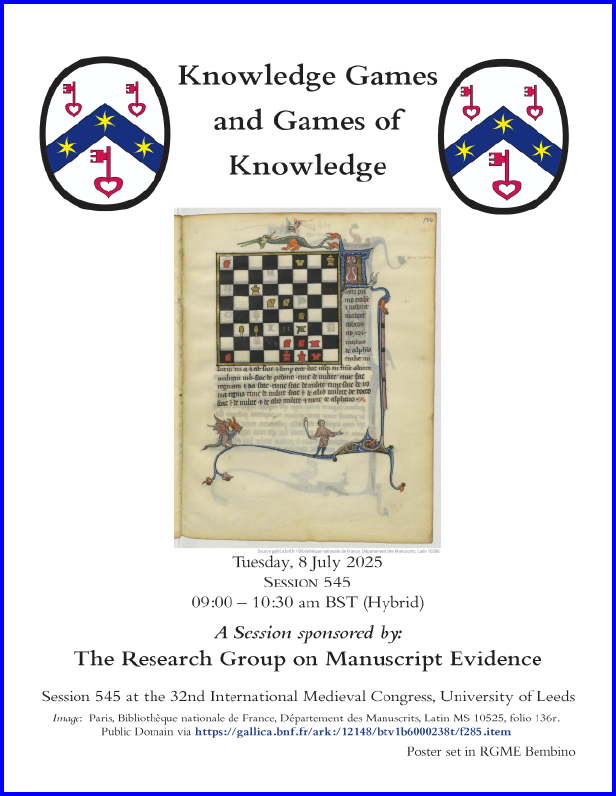
2025 Leeds: “Knowledge Games and Games of Knowledge” Poster 1. Set in RGME Bembino.
For the 2026 ICMS, we seek to examine games and playful approaches of multiple kinds with regard to manuscripts. The opportunities across time range from the creation of a book to its use in the world. We observe, for example, habits of entering scribbles and sketches as spontaneous or imaginative playtime on the one hand to creating and transmitting texts about games or gaming strategies.
Aims
By their nature, whether text or image, the planarity of manuscript surfaces offers invitations for readers to engage with them playfully. This play entails a process of temporalisation, of setting manuscript elements into motion, resulting in configurations and re-configurations that are keys for deciphering hidden — or less apparent — meanings. While carmina figurata or picture poems may range among the most obvious examples, they are by no means limited to them. Such elements can include scribbles and sketches, diagrams (including game diagrams specifically), material extensions (such as volvelles and other pop-up features), acrostics, and other puzzles. We consider the performativity and dynamics at work, or play, on the pages.
We examine a wide range of materials and genres and from a variety of perspectives, to consider case-studies, work-in-progress, or research results celebrating the roles of play in which manuscripts engage, and which they might inspire in us as readers, scholars, and beholders.
Want to play? Are you game?
Our Session
“Manuscripts At Play and As Play:
(Re)Configurations as Reading Methods”
IMC Session 609 – Hybrid
(2026 IMC Programme, page 160)
Laidlaw Librari, Teaching Room 2
For Location see:
- Campus Map, Number 63:
Sponsor:
Research Group on Manuscript Evidence
Organisers:
Mildred Budny
Research Group on Manuscript Evidence, New Jersey
and
Michael Allman Conrad
Moderator:
N. Kıvılcım Yavuz
Institute for Medieval Studies / School of History, University of Leeds
Presentators
1. Michael A. Conrad
Fachbereich Literatur-, Kunst- und Medienwissenschaften, Universität Konstanz
“Can There Be Fun in Coding and Decoding?:
What Game Theory Has to Say about Medieval Carmina Figurata”
(Language: English)
2. Mildred Budny
Research Group on Manuscript Evidence, New Jersey
“Pages and Words at Play across Time:
Text as Puzzles and Images as Playful Creations”
(Language: English)
Respondents
1. Antony R. Henk
Englisches Seminar, Ruhr-Universität Bochum
2. David Porreca
Department of Classical Studies, University of Waterloo, Ontario
************
Images
To whet the appetite, we survey some evocative images-on-pages, pages-as-images, and words-as-image in the remarkable genre of picture poems.
Examples of dynamic constructions involving word-play upon the page include the elaborate, intricate, and beautiful picture-poems favoured among some authors, not least at in the early medieval period. We display specimens by the Carolingian author Hrabanus (or Rabanus) Maurus Magnentius (circa 780 – 856), Archbishop of Mainz (from 847). His poem De laudibus sanctae crucis (“In Praise of the Holy Cross”), which survives in multiple copies, contains a series of poems laid out as rectangular constructions in which each line contains the same number of letters as any other.
Their patterns make it possible to lay out the letters not only in horizontal lines but also in vertical rows, strictly in line with each other. Moreover, it is possible to read key portions vertically as well as horizontally. Reading vertically in a line using the initial, medial, or final letter of each line yields an acrostic, mesostic, or telestic. Such forms of cross-word puzzles can produce wonders of legibility, requiring the attention in steps of time to gain comprehension of the message as a whole. Adding images to the ensemble increases the layering of meanings, and the possibilities of wonderment through resonance.
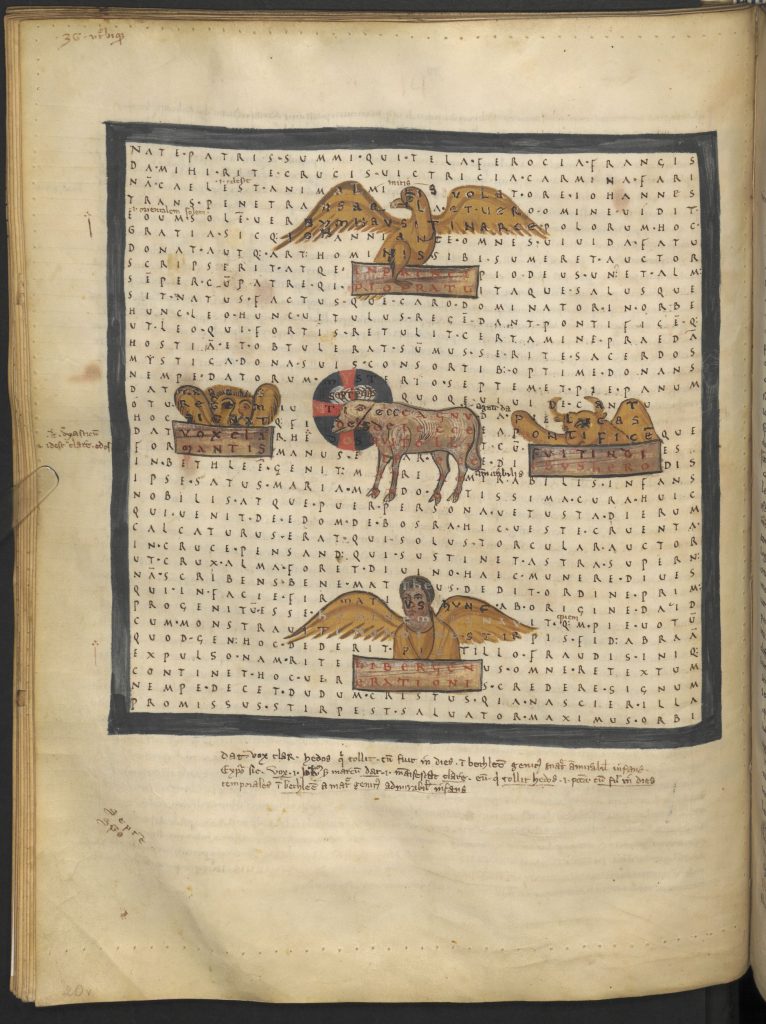
Vienna, Österreichische Nationalbibliothek, Cod. 652, fol. 20v (scan 50 of 109). Hrabanus Maurus, De laude sanctae crucibus. Mainz or Fulda, 9th century (circa 830-840). Carmen figuratum with four Evangelist symbols surrounding the Lamb of God. Image via https://viewer.onb.ac.at/10048D05/.
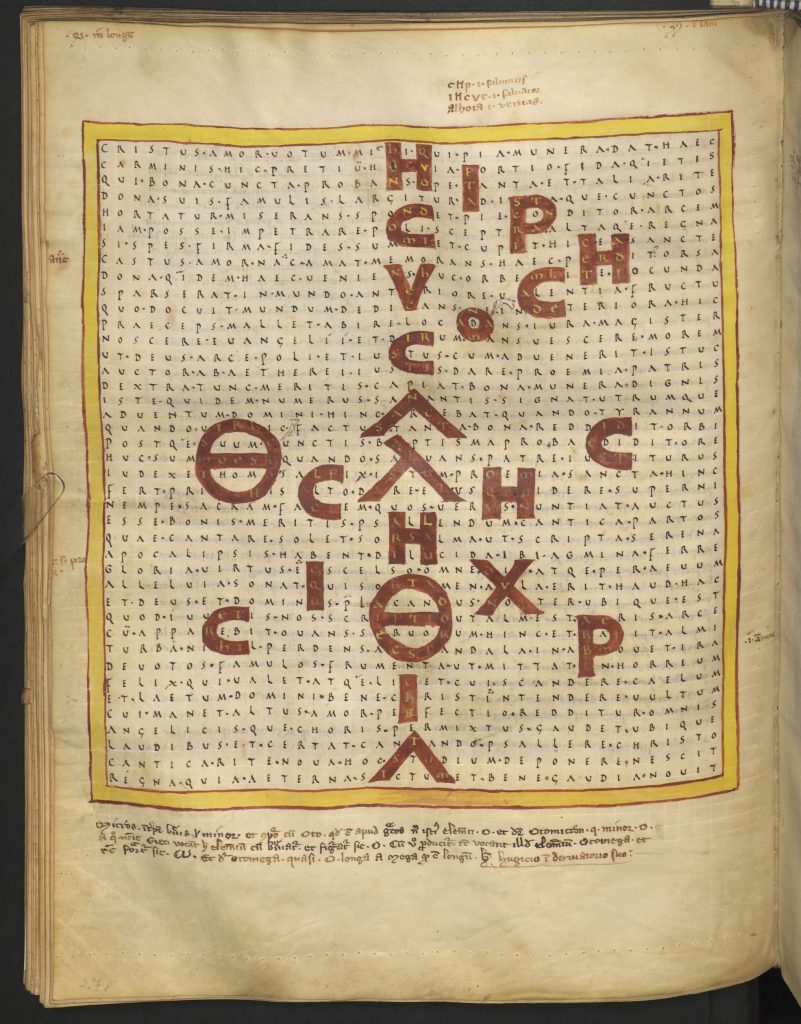
Vienna, Österreichische Nationalbibliothek, Cod. 652, fol.
Image https://viewer.onb.ac.at/10048D05/.
Questions or Suggestions?
- Leave your comments or questions below
- Contact Us
- Sign up for our Newsletter and information about our activities.
Send a note to director@manuscriptevidence.org or RGMEevents@gmail.com
Visit our Social Media:
- our FaceBook Page
- our Facebook Group
- our Twitter Feed (@rgme_mss)
- our Bluesky nest @rgmesocial.bluesky.social)
- our LinkedIn Group
Join the Friends of the RGME.
Register for our Events by the RGME Eventbrite Collection.
Consider making a Donation in Funds or in Kind for our nonprofit educational corporation powered principally by volunteers. Your donations and contributions are welcome, and can go a long way. They may be tax-deductible to the fullest extent provided by the law.
We look forward to hearing from you and welcoming you to our events.
***********