
• News
    • News & Views
    • RGME Activities for 2024 and 2025
    • Around & About with the RGME
    • Reviews
    • Highlights
  • Blogs
    • Manuscript Studies
      • Manuscript Studies: Contents List
    • International Congress on Medieval Studies
      • Abstracts of Congress Papers
        • Abstracts of Papers Listed by Author
        • Abstracts of Papers Listed by Year
  • About
    • Mission
    • Who We Are
      • Officers, Associates & Volunteers
      • RGME Committees
      • Friends of the Research Group on Manuscript Evidence
    • Policies & Statements
      • RGME Privacy Policy Statement
      • RGME Intellectual Property Statement & Agreements
    • People
      • Mildred Budny — Her Page
      • Adelaide Bennett Hagens
    • Activities
      • Events
      • Congress Activities
        • Sponsored Conference Sessions (1993‒)
          • Panels at the M-MLA Convention (from 2016)
        • Co-sponsored Conference Sessions (2006‒)
    • History
      • Seals, Matrices & Documents
      • Genealogies & Archives
    • Contact Us
  • Bembino
    • Multi-Lingual Bembino
    • RGME Bembino: Resources
  • Congress
    • Sponsored Conference Sessions (1993‒)
    • Co-sponsored Conference Sessions (2006‒)
    • Abstracts of Congress Papers
      • Abstracts Listed by Author
      • Abstracts Listed by Year
    • Kalamazoo Archive
    • Panels at the M-MLA Convention (2016-2019)
      • Abstracts of Papers for the M-MLA Convention
      • Panels at the M-MLA Convention (from 2016)
  • Events
    • RGME Activities for 2024 and 2025
      • 2023 Activities and 2024 Planned Activities
    • Seminars, Workshops, Colloquia & Symposia (1989–)
      • Seminars on ‘The Evidence of Manuscripts’
      • Symposia on ‘The Transmission of the Bible’
      • The New Series (2001-)
        • 2019 Anniversary Symposium Program: The Roads Taken
        • 2019 Anniversary Symposium Registration
        • 2019 Anniversary Symposium Registration Open
      • RGME Symposia: The Various Series
      • The Research Group Speaks: The Series
      • Meetings of the Friends of the Research Group on Manuscript Evidence
      • RGME Online Events
    • Abstracts of Papers for Events
      • Abstracts of Papers for Seminars on ‘The Evidence of Manuscripts’
      • Abstracts of Papers for Symposia, Workshops & Colloquia
    • Receptions & Parties
    • Business Meetings
    • Photographic Exhibitions & Master Classes
    • Events Archive
  • ShelfLife
    • Journal Description
    • ShelfMarks: The RGME-Newsletter
    • Publications
      • “Insular, Anglo-Saxon, and Early Anglo-Norman Manuscript Art at Corpus Christi College, Cambridge” (1997)
        • Mildred Budny, ‘Catalogue’
        • The Illustrated Catalogue (1997)
      • The Illustrated Handlist
      • Semi-Official Counterfeiting in France 1380-1422
      • No Snap Decisions: Challenges of Manuscript Photography
    • History and Design of Our Website
  • Galleries
    • Watermarks & the History of Paper
    • Galleries: Contents List
    • Scripts on Parade
    • Texts on Parade
      • Latin Documents & Cartularies
      • New Testament Leaves in Old Armenian
    • Posters on Display
    • Layout Designs
  • Donations and Contributions
    • RGME Donor Promise
    • 2023 End-of-Year Fundraiser for our 2024 Anniversary Year
    • 2019 Anniversary Appeal
    • Orders
  • Links
    • Catalogs, Metadata, and Databases: A Handlist of Links
    • Handlist of Resources for Manuscript Studies and Fragmentology
    • Manuscripts & Rare Books
    • Maps, Plans & Drawings
    • Seals, Seal-Matrices & Documents

  • News
    • News & Views
    • RGME Activities for 2024 and 2025
    • Around & About with the RGME
    • Reviews
    • Highlights
  • Blogs
    • Manuscript Studies
      • Manuscript Studies: Contents List
    • International Congress on Medieval Studies
      • Abstracts of Congress Papers
        • Abstracts of Papers Listed by Author
        • Abstracts of Papers Listed by Year
  • About
    • Mission
    • Who We Are
      • Officers, Associates & Volunteers
      • RGME Committees
      • Friends of the Research Group on Manuscript Evidence
    • Policies & Statements
      • RGME Privacy Policy Statement
      • RGME Intellectual Property Statement & Agreements
    • People
      • Mildred Budny — Her Page
      • Adelaide Bennett Hagens
    • Activities
      • Events
      • Congress Activities
        • Sponsored Conference Sessions (1993‒)
          • Panels at the M-MLA Convention (from 2016)
        • Co-sponsored Conference Sessions (2006‒)
    • History
      • Seals, Matrices & Documents
      • Genealogies & Archives
    • Contact Us
  • Bembino
    • Multi-Lingual Bembino
    • RGME Bembino: Resources
  • Congress
    • Sponsored Conference Sessions (1993‒)
    • Co-sponsored Conference Sessions (2006‒)
    • Abstracts of Congress Papers
      • Abstracts Listed by Author
      • Abstracts Listed by Year
    • Kalamazoo Archive
    • Panels at the M-MLA Convention (2016-2019)
      • Abstracts of Papers for the M-MLA Convention
      • Panels at the M-MLA Convention (from 2016)
  • Events
    • RGME Activities for 2024 and 2025
      • 2023 Activities and 2024 Planned Activities
    • Seminars, Workshops, Colloquia & Symposia (1989–)
      • Seminars on ‘The Evidence of Manuscripts’
      • Symposia on ‘The Transmission of the Bible’
      • The New Series (2001-)
        • 2019 Anniversary Symposium Program: The Roads Taken
        • 2019 Anniversary Symposium Registration
        • 2019 Anniversary Symposium Registration Open
      • RGME Symposia: The Various Series
      • The Research Group Speaks: The Series
      • Meetings of the Friends of the Research Group on Manuscript Evidence
      • RGME Online Events
    • Abstracts of Papers for Events
      • Abstracts of Papers for Seminars on ‘The Evidence of Manuscripts’
      • Abstracts of Papers for Symposia, Workshops & Colloquia
    • Receptions & Parties
    • Business Meetings
    • Photographic Exhibitions & Master Classes
    • Events Archive
  • ShelfLife
    • Journal Description
    • ShelfMarks: The RGME-Newsletter
    • Publications
      • “Insular, Anglo-Saxon, and Early Anglo-Norman Manuscript Art at Corpus Christi College, Cambridge” (1997)
        • Mildred Budny, ‘Catalogue’
        • The Illustrated Catalogue (1997)
      • The Illustrated Handlist
      • Semi-Official Counterfeiting in France 1380-1422
      • No Snap Decisions: Challenges of Manuscript Photography
    • History and Design of Our Website
  • Galleries
    • Watermarks & the History of Paper
    • Galleries: Contents List
    • Scripts on Parade
    • Texts on Parade
      • Latin Documents & Cartularies
      • New Testament Leaves in Old Armenian
    • Posters on Display
    • Layout Designs
  • Donations and Contributions
    • RGME Donor Promise
    • 2023 End-of-Year Fundraiser for our 2024 Anniversary Year
    • 2019 Anniversary Appeal
    • Orders
  • Links
    • Catalogs, Metadata, and Databases: A Handlist of Links
    • Handlist of Resources for Manuscript Studies and Fragmentology
    • Manuscripts & Rare Books
    • Maps, Plans & Drawings
    • Seals, Seal-Matrices & Documents

Log in

Archives

Featured Posts

2026 “Transformations & Renewals”: The RGME visits Treasures of the Grolier Club Library
"Bembino" Booklet Cover
Episode 23. “Meet RGME Bembino: Facets of a Font”
2026 Theme of the Year: “Transformations and Renewals”
A Leaf with Patchwork from the Saint Albans Bible
A Sister Leaf from a Miniature Latin Vulgate Bible
A Little Latin Vulgate Bible Manuscript Leaf in Princeton
J. S. Wagner Collection. Leaf from from Prime in a Latin manuscript Breviary. Folio 4 Verso, with part of Psalm 117 (118) in the Vulgate Version, set out in verses with decorated initials.
2026 Annual Appeal
Episode 22: “Encounters with Local Saints and Their Cults”
Private Collection, Ege's FBNC Portfolio, Dante Leaf, Verso, Detail. Reproduced by Permission.
2025 RGME Autumn Colloquium on Fragments
Workshop 8: A Hybrid Book where Medieval Music Meets Early-Modern Herbal
2025 RGME Autumn Symposium on “Readers, Fakers, and Re-Creators of Books”
RGME Workshops on “The Evidence of Manuscripts, Etc.”
2025 International Medieval Congress at Leeds: RGME Program
Episode 21. “Learning How to Look”
2025 International Congress on Medieval Studies: Program
2025 RGME Visit to Vassar College
Two Leaves in the Book of Numbers from the Chudleigh Bible
Delibovi on Glassgold on Boethius: A Blogpost
Ronald Smeltzer on “Émilie du Châtelet, Woman of Science”
2025 Spring Symposium: “Makers, Producers, and Collectors of Books”
Starters’ Orders
The Weber Leaf from the Saint Albans Bible
Workshop 4. “Manuscript Fragments Compared”
Episode 20. “Comic Book Theory for Medievalists”
Episode 19: “At the Gate: Starting the Year 2025 at its Threshold”
Favorite Recipes for Lemonade, Etc.
RGME Visit to the Lomazow Collection: Report
2024 Autumn Symposium: “At the Helm”
A Latin Vulgate Leaf of the Book of Numbers
The RGME ‘Lending Library’
Florence, Italy, Ponte Vecchio from Ponte alle Grazie. Photo: Ingo Mehling, CC BY-SA 4.0 , via Wikimedia Commons
Episode 17. “RGME Retrospect and Prospects: Anniversary Reflections”
2024 Anniversary Symposium: The Booklet
Jesse Hurlbut at the Bonneville Salt Flats, Utah. Photograph Jesse Hurlbut.
Episode 16: An Interview with Jesse D. Hurlbut
To Whom Do Manuscripts Belong?
Kalamazoo, MI Western Michigan University, Valley III from the side. Photograph: David W. Sorenson.
2024 International Congress on Medieval Studies: Report
2024 Spring Symposium at Vassar College
Puente de San Martín: Bridge with reflection over the River Targus, Toledo, Spain.
2024 Grant for “Between Past and Future” Project from The Gladys Krieble Delmas Foundation Research Libraries Program
2024 Anniversary Symposium in Thanks to Jesse Hurlbut: Program

You are browsing the Blog for Saint Albans Bible

A Leaf with Patchwork from the Saint Albans Bible

December 29, 2025 in Fragments, Manuscript Studies

A Leaf with Patchwork
from the Saint Albans Bible
in the Collection of William Voelkle

Double columns of 46 lines in Gothic Script
with 2-line Decorated Initials, Bar-Extensions,
Foliate Ornament,
and Marginal Inhabitants (Monkey, Dragon, Bird)

Northern France, circa 1330

Psalms 107:14 ([facerimus uir-]/tutem et ipse)
– 108:31 (a persequentibus [animam meam] )
and 109:2 ([tuorum te-]cum principium . . . )
– 110:6 (. . . operum suorum / [adnuntiabit populo suo])

Plus Cut-Out with Patch apparently from the Same Bible
Cut out (in 14 lines of one column):
Psalms 109:1–2 (Dixit Dominus domino meo . . . tuorum te-/]cum principium)
Replacement Patch (in 14 lines pasted to opposite side):
Epistle of James 1:11–15 (peccatum uero cum / [consummatum fuerit]

[Posted on 27 December 2025]

Collection of William Voelkle, Framed Leaf from the Saint Albans Bible: Recto under glass. Photograph by William Voelkle.

Our series of RGME Workshops on “The Evidence of Manuscripts, Etc.”, continues to uncover more leaves from the fragmentary manuscripts which the workshops consider, by request. Now we report another leaf from the Saint Albans Bible, with which our workshops began.

We set the stage by reviewing two leaves which generated our interest in this manuscript and its fragments. They belong to the Farrell and Weber Collections respectively, with portions from the Old Testament and the New Testament respectively.

The ‘new’ leaf belongs to the Collection of William Voelkle. Its pieced-together pieces represent parts of one Book from the Old Testament and another from the New Testament.

The patchwork, replacing a cut-out portion with a cutting from elsewhere in the volume, resembles a phenomenon which we explored previously in another fragmentary Vulgate Bible, the larger Lectern Bible dispersed by Otto F. Ege as his Number 14.
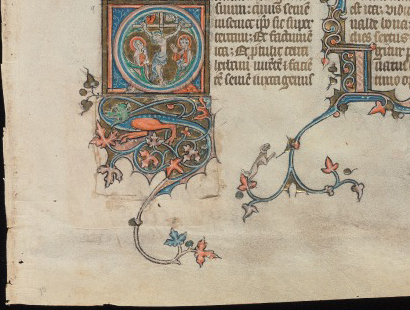
  • Patch Work in Otto Ege MS 14
Beinecke Rare Book & Manuscript Library, Otto Ege Collection, MS 14, Genesis Opening Leaf: Recto, Detail of Patch.

Beinecke Rare Book & Manuscript Library, Otto Ege Collection, MS 14, Genesis Opening Leaf: Recto, Detail of Patch.

Beinecke Rare Book & Manuscript Library, Otto Ege Collection, MS 14, Genesis Opening Leaf: Verso, Detail of Patch.

Beinecke Rare Book & Manuscript Library, Otto Ege Collection, MS 14, Genesis Opening Leaf: Verso, Detail of Patch.

1. The Farrell Leaf
(from the Book of Numbers)

Our workshops first examined a leaf on loan to the RGME with part of the text of the Book of Numbers in a Latin Vulgate Bible in double columns of 46 lines in Gothic script, with decorative elements. Reports of our discoveries about that leaf have been reported in our blog on Manuscript Studies.

  • A Latin Vulgate Leaf from the Book of Numbers (Part 1)
  • Latin Vulgate Bible Leaf in the Collection of Jennah Farrell, Part 2: Provenance
  • The Latin Vulgate Bible Leaf in the Farrell Collection Part 3: The Full Leaf
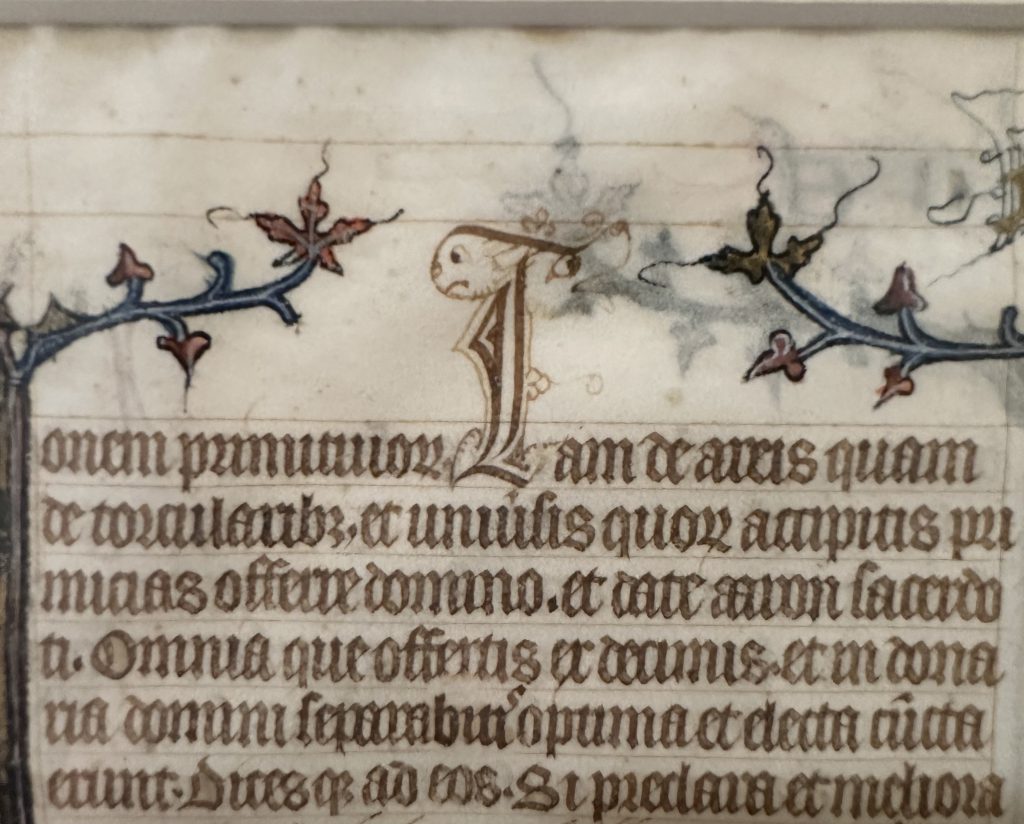
Collection of Jennah Farrell, Manuscript Leaf in Mat: top left. Photograph by Jennah Farrrell.

Recto

Collection of Jennah Farrell, Single Leaf from the Book of Numbers in a Medieval Latin Vulgate Bible manuscript. Full extent of the leaf, unframed: Recto. Photography by Mildred Budny.

Verso

Collection of Jennah Farrell, Latin Vulgate Bible Leaf: Verso with Ruler. Photograph by Mildred Budny.

2. The Weber Leaf
(from the Acts of the Apostles)

As the workshops progressed, our Associate Richard Weber revealed another leaf from this manuscript in his collection, to join our blogposts about various items in his collection. Unlike the first leaf considered in our workshops, from the Old Testament Book of Numbers, this leaf belongs to the New Testament portion of the bible, from within the text of the Acts of the Apostles. See

  • The Weber Leaf from the Saint Albans Bible

Collection of Richard Weber, Leaf from the Saint Albans Bible, Verso: Top Left. Photograph by Richard Weber.

Recto

Collection of Richard Weber, Leaf from the Saint Albans Bible, Recto. Photograph by Richard Weber.

Verso

Collection of Richard Weber, Leaf from the Saint Albans Bible, Recto. Photograph by Richard Weber.

Collection of William Voelkle, Framed Leaf from the Saint Albans Bible: Recto under glass. Photograph by William Voelkle.

3. The Voelkle Leaf
(from the Psalms
and the Epistle of James)
—A Patchwork Leaf

Next, our Associate William Voelkle sent a photograph of his leaf from the Saint Albans Bible.

About the leaf, William Voelkle reported that

I purchased the leaf from Philip Duschnes (NY dealer) August 10, 1983, as ‘repaired.’ The historiated miniature had been cut out and replaced with another section of the text.
— email of 29 December 2025

About Duschnes and his business, see, for example Philip C. Duschnes.

Contained within a glass-fronted frame, the leaf shows one side, but turns the other side to the back of the frame, where it remains hidden.

We examine the visible side, with glimpses also of the opposite side as revealed by show-through and other evidence.

Recto (the Visible Side)

Collection of William Voelkle, Framed Leaf from the Saint Albans Bible: Recto. Photograph by William Voelkle.

The page has no running title, unlike some other parts of the Saint Albans Bible (see above).

Mainly the text on the page presents part of the Book of Psalms, plus a replacement patch for fourteen lines cut out from one column, which removed the first lines of Psalm 109.

A modern pencil note at the left opposite line 3 of the left-hand column identifies the number of the Vulgate Psalm (“108”) which opens there (Deus laudem meam me tacueris). It seems likely that the note postdates the dismemberment of the manuscript, so that an identification of the contents of the leaf might be appropriate, starting with the first of the Psalms on the page.

Rubrication in red pigment announces the start of Psalms 108 and 110 — perhaps it did so also for the opening of Psalm 109, but that title would have been lost in the cut-out.

Show-through from the opposite side reveals (in mirrored view) the presence of polychrome bar ornament in verticals along the inner and outer margins as well as the intercolumn — that is, at the left-hand side of both columns of text on that page and, to a less marked extent, at the right-hand side of the outer column — and in branching formations at both upper and lower margins.

The Texts:
Parts of Two Different Books of the Bible

The visible side of the leaf carries text principally from the Book of Psalms. It begins midword within Psalms 107:14 ([facerimus uir-]/tutem et ipse) and ends within Psalms 110:31 (operum suorum / [adnuntiabit populo suo]). The text carries the full text of Psalm 108, but only the last part of Psalm 109, because its first lines have been cut out and removed, taking the opening initial and the adjacent section of its intercolumnar bar ornament at the left. Untouched was the bar ornament at the right-hand side, along with the full-length bird perched in profile upon its foliage.

The Psalms text in column a and the upper and lower parts of column b:

Psalms 107:14 ([facerimus uir-]/tutem et ipse) – 108:31 (a persequentibus /[animam meam])
and (after the gap produced by the cut-out)
Psalms 109:2 (tuorum te-/]cum principium) – 110:1–6 (operum suorum / [adnuntiabit populo suo])

Missing text cut out from column b:

Psalms 109:1–2 ([Dixit dominus Domino meo . . . tuorum te-]cum principium)

Replacement patch of fourteen lines in a single column:

Epistle of James 1:11–15 (Exortus est enim . . . peccatum uero cum / [consummatum fuerit]

Untouched in the cutting process was the bar ornament at the right-hand side, along with the full-length bird perched upon its foliage. Seen in profile facing left, the bird raises its offside leg and its head to look up to the left. Might the bird perhaps depict a thrush or strike?

Collection of William Voelkle, Framed Leaf from the Saint Albans Bible: Recto under glass, Midsection with patch. Photograph by William Voelkle.

A patch in the second column supplies a passage of fourteen lines of text where the original text had been cut out — presumably as a specimen of text and/or decoration. The supplied portion presents similar layout, script, structure, and intercolumnar border decoration as characteristic of the Saint Albans Bible, so perhaps or presumably another leaf from the same book supplied the gap. Certainty about the source of the replacement might become clearer if, say, the portion of the Epistle of James in the volume can be identified either intact or defective.

Collection of William Voelkle, Framed Leaf from the Saint Albans Bible: Recto under glass, Detail with patch. Photograph by William Voelkle.

The bar ornament at the left on the replacement patch is broader than the bar ornament which it supplants or interrupts in the intercolumn of the Psalms leaf, although its undulating ornamental pattern and coloring resembles that bar. The extensions to the left from the replacement bar imply that this patch came from a left-hand column on its former page, reaching into the inner margin.

The Decoration and Figural Ornament

Ornamented initials stand at the openings of the individual Psalms, as inset 2-line polychrome capitals within frames. From their left-hand side, extensions might rise or descend along the side of the column of text to curve into the upper or lower margins in elaborate branching foliate motifs. The individual verses of the Psalms open within the continuous lines of text as inset 1-line capitals, rendered alternately in blue pigment or gold, within beds of penline decoration.

Top

Collection of William Voelkle, Framed Leaf from the Saint Albans Bible: Recto under glass, Top. Photograph by William Voelkle.

Bottom

Collection of William Voelkle, Framed Leaf from the Saint Albans Bible: Recto under glass, Lower portion. Photograph by William Voelkle.

Seen in profile, the animated elements in the lower margin comprise

1) a charming undulating dragonesque creature with raised wings at the outer right, an elongated neck, and an open-mouthed head facing right with a dog-like head having pointed ears and a bearded lower jaw; and

2) an upright monkey striding toward the left. In its outstretched hands this creature holds an implement which might depict a spindle and whorl.

Below the monkey’s feet, two foliate terminals of the border ornament have descending streaks of ink and pigment which damaged the page at an unknown stage.

Collection of William Voelkle, Framed Leaf from the Saint Albans Bible: Recto under glass, detail: monkey. Photograph by William Voelkle.

Questions or Suggestions?

Do you know of other leaves from this Bible? Do you know of other works by the same scribe(s) or artist(s)? We welcome your feedback.

*************

Tags: Collection of Richard Wagner, Collection of William Voelkle, Fragmentology, Jennah Farrell Collection, manuscript fragments, Manuscript Illumination, Otto Ege MS 14, Patchwork in Manuscripts, RGME Workshops on the Evidence of MSS Etc., Saint Albans Bible, Vulgate Bible Manuscripts
No Comments »

The Weber Leaf from the Saint Albans Bible

February 22, 2025 in Manuscript Studies, Workshops on "The Evidence of Manuscripts"

Leaf from the Saint Albans Bible
in the Collection of Richard Weber

Double columns of 46 lines in Gothic Script
with Decorated Initials, Bar-Extensions,
and Running Titles
Acts 26:14 (est tibi) – Acts 28:9 (insula habe[/-bant] )

Northern France, circa 1330

Collection of Richard Weber, Leaf from the Saint Albans Bible, Recto: Top Right. Photograph by Richard Weber.

[Posted on 21 February 2025]

In connection with our new series of RGME Workshops on “The Evidence of Manuscripts, Etc.”, our Associate, Richard Weber, revealed another leaf in his collection. This discovery joins the posts about different items in his collection which have been reported in our blog on Manuscript Studies.

Our workshops began by examining a leaf on loan to the RGME with part of the text of the Book of Numbers in a Latin Vulgate Bible in double columns of 46 lines in Gothic script, with decorative elements. See the reports of our discoveries about that leaf:

  • A Latin Vulgate Leaf from the Book of Numbers (Part 1)
  • Latin Vulgate Bible Leaf in the Collection of Jennah Farrell, Part 2: Provenance
  • The Latin Vulgate Bible Leaf in the Farrell Collection Part 3: The Full Leaf

Collection of Jennah Farrell, Single Leaf from the Book of Numbers in a Medieval Latin Vulgate Bible manuscript: Recto, top. Photography by Mildred Budny.

The collaborative work in our workshops, crowdsourcing the quest to identify the leaf, has revealed that it most probably came from the dismembered Saint Albans Bible, produced in Northern France in the 1320s or 1330s and formerly owned by Saint Albans’ Abbey. Our search among online resources, such as blogposts and vendors’ sites, and in printed works, ranging from books and journal articles to catalogues of sales or individual collections, followed up clues leading from one collection or sales room to another.

Collection of Jennah Farrell, Single Leaf from the Book of Numbers in a Medieval Latin Vulgate Bible manuscript: Recto. Photography by Mildred Budny.

The process of discovery persuaded us, from the resemblances between the leaf in hand and features of some surviving leaves from the Saint Albans Bible, that this leaf very likely came from the same manuscript — if not from another much like it by some of the same scribes and artists. We believe that proof positive (or the like) for this conjectured identification might come were one or both of the leaves which formerly directly preceded and directly followed the leaf to emerge into the light so as to demonstrate an exact match in the flow of text from one to the next.

And so we continue our search among the survivors, as we track the leaves from both the Old and New Testaments in the Saint Albans Bible, especially from the Book of Numbers. In view might be, were time and resources available, the creation of a virtual reconstruction of the manuscript, as has been accomplished or begun for various other manuscripts which now survive in fragments scattered across many locations.

Learning from our workshops that the Farrell Leaf is identifiable most probably as part of the dismembered Saint Albans Bible, our Associate, Richard Weber, reported the presence of another leaf from the same manuscript in his collection. With his permission, for which we give thanks, we introduce it to you and our Workshop Series, starting with RGME Workshop 4: “Manuscript Fragments Compared”.

The Weber Leaf
from the Saint Albans Bible

Acquired on May 23, 2023, from The Raab Collection (Nathan “Nate” Raab and Karen Pearlman Raab), this leaf preserves part of the Acts of the Apostles in the Saint Albans Bible, which was dismembered for resale in 1964. The leaf comes from the last part of the Book of Acts. It breaks off mid-word in its final chapter, about one-third of the way through it.

The Apostle Paul, His Travels, and His Travails

The text on the leaf presents the text from within Chapter 26 to within Chapter 28 of Acts in the Latin Vulgate Version. It opens within verse 14 ([persequeris durum /] est tibi contra) of Chapter 26, completes the chapter, turns to the full span of Chapter 27, and opens the last chapter of the Book up to its verse 9, whereupon it breaks off mid-word (insula habe[/-bant infirmitates]). That is, the span of text encompasses Acts 26:14–32 (the latter portion of the chapter); Acts 27:1–44 (the full chapter); and Acts 28:1–9 (the first third).

The leaf contains most of the extended first-hand account by the Apostle Paul (circa 5 – circa 64/65 AD) of his life’s adventures in his defense before King Herod Agrippa II of Judea (27/28 – 92 or 100 AD). From his own viewpoint, we hear about his transformation from soldier and Roman citizen to apostle in locations stretching from Tarsus in Asia Minor to Jerusalem, Antioch, Thessaloniki, Athens, Corinth, Ephesus, Malta, and finally Rome.

The scope, range, and variety of his exploits or adventures are illustrated vividly in some medieval manuscript illustrations. Notable among them is the full-page, multi-tiered cycle of scenes rendered by an exceptional master artist in the large-format Carolingian version of the Latin Vulgate Bible prepared at Tours for presentation to the monarch Charles the Bald (823–877). On this imposing Bible, see, for example, Latin 1.

Paris, Bibliothèque nationale de France. Département des Manuscrits. Latin 1, fol. 386v. Image Public Domain via https://gallica.bnf.fr/ark:/12148/btv1b8455903b/f780.item#.

The Leaf, Its Contents, and Its Presentation

Sections of the text are demarcated by

1) enlarged, decorated initials rendered in polychrome or in ink,
2) ornamental vertical bars extending from the 2-line inset polychrome Chapter Initials to foliate terminals,
3) ornamental or figurative motifs embellishing the enlarged pen-initial in the top line of all but one column,
4) polychrome chapter numerals,
5) polychrome running titles in the upper margins, rendered partly in alternating pigments and partly in pen-line flourishes, and
6) a marginal ‘insertion’ of script to correct an omission in the text.

Let us have a closer look.

The Recto

The recto of the Weber Leaf

Collection of Richard Weber, Leaf from the Saint Albans Bible, Recto. Photograph by Richard Weber.

Lively decorated letters rendered in ink rise to considerable heights in the first lines of each column of text, one to each column. In column a, E for Ego opens Verse 15 of Chapter 26. In column b, T completes the opening word UT of Chapter 27:1.

The two-part running title at the top spaces its words at a distance from each other. It keeps the first part (Actus) more-or-less centered above the two columns and places the second, abbreviated word (Ap[osto]lor[um]) offset extending partway into the margin.

The distant, offset half of the running title appears like an afterthought, although apparently as the work of the same scribal artist and during the same campaign of operation (if not at the same sitting). Could it represent a correction to supplement the ‘mistake’ of putting the first component, Actus, on the recto of an opening, rather than on the verso?

On the verso of a two-page opening, with the verso of one leaf facing the recto of the next, customarily a bipartite running title for one set text on both pages might have the first half or portion of a single title on the verso and the continuation in the second half or portion on the recto. What if this leaf received the Actus as if it were a verso, so that its match or completion, Apostolorum, was deemed to need to be fitted in? We wonder what the verso originally facing this leaf had for its running title.

Collection of Richard Weber, Leaf from the Saint Albans Bible, Recto: Top Right. Photograph by Richard Weber.

The Verso

Collection of Richard Weber, Leaf from the Saint Albans Bible, Verso. Photograph by Richard Weber.

This side of the leaf retains the use of a tall ink-drawn letter in the top line, but only for one column. The initial U or V for Valida opening 27:18

The running title keeps to its short form of one word (or syllable) only. Presumably the second part of the title appeared facing it on the recto of the next leaf. We are uncertain what intentions were in place for this enigmatic running title comprising DE (“Of”, “About”), which seems to stand in a suspended state awaiting the completion of a name or phrase on the formerly facing recto. Here is another mystery awaiting resolution, if possible, with the discovery of the next leaf in the sequence in the original book.

Collection of Richard Weber, Leaf from the Saint Albans Bible, Recto: Top Center. Photograph by Richard Weber.

The first stem of the animated pen-initial U atop Column a (the left-hand column of the pair on the page) on the verso rises to a backwards and downwards curve containing the shaggy neck and head of a wide-eyed creature with opened jaws with exposed teeth and fangs. One might wonder if the apparent ferocity of the creature emulates or evokes the stormy text of the verse which this initial opens (27:18), as it reads: Valida autem nobis tempestate jactatis sequenti die jactum fecerunt (“And we exceedingly tossed with a tempest, the next day they lightened the ship.”) Might we think of this creature as presenting the Jaws of a Tempest?

Collection of Richard Weber, Leaf from the Saint Albans Bible, Verso: Top Left. Photograph by Richard Weber.

The Seller’s Description

Richard shares with us the description which accompanied the leaf in preparation for its sale by The Raab Collection in 2023. This description deserves to join the growing group of sellers’, collectors, scholars’, curators’, and others’ descriptions of individual leaves or groups of leaves which are present, for a time, in their hands and before their eyes.

As such they can constitute direct witnesses to surviving portions of the manuscript. Our work toward a collaborative virtual reconstruction of the original will also assemble the descriptions as a contribution toward fuller knowledge of the manuscript and its stages of ownership, study, and wider understanding.

We quote:

The Saint Alban’s Bible started life in Paris in the 1320s or 1330s. Likely, three artists worked together in an atelier, or workshop, to create the high quality product. The workshop to which Christopher de Hamel attributes the creation is that of the famed Parisian artist, Jean Pucelle, one of the most important and influential artists for the Gothic style. While the Saint Alban’s Bible is not in the hand of John Pucelle, it is in the hands of his associates, the Saint Louis Master, whose name has been identifed as Mahiet (Kuroiwa, “Working with Jean Pucelle”). On the margins of another manuscript illustrated by the Saint Louis Master, housed in the Bibliotheque Nationale de France in Paris, a marginal note from Pucelle to an illuminator, Mahiet, confirms the Saint Louis Master’s identity. Through the association of the Saint Albans Bible with Mahiet and Pucelle, a complex network of Parisian bookmakers opens up, and their works can be traced.

From its manufacture on the Rue de la Parcheminerie, the Bible was likely a gift from Richard de Bury, Bishop of Durham to the Abbey of Saint Albans after his 1320-1330s visit to Paris (de Hamel, “Leaf of a Bible Manuscript”). Leaves have ended up in collections such as the Tokyo National Museum of Western Art, the University of Colorado at Boulder, and the University of British Columbia, with others in private hands. The post-medieval lives of manuscripts, as they fragment and change hands, demonstrates their endurance as status symbols and works of art— as a whole and as a part.

The text gives part of Paul’s recount of his life story to King Agrippa who is almost persuaded to become a Christian. The imprisoned Paul’s ship runs aground and he is shipwrecked in Malta on his way to face trial in Rome. The barbarians of Malta show Paul and the shipwrecked crew kindness by building a fire, but a viper emerged from the ashes and bit Paul’s hand, though he did not die.

Provenance: 1. From an incomplete Bible sold at Sotheby’s, 6 July 1964, lot 239, to the dealer and book-breaker Philip C. Duschnes [1897–1970], who dispersed it. Other leaves had already been removed, with some ending up in the collections of E.H. Dring (1864-1928), one reappearing in Bernard Quaritch, cat. 1036, 1984, no. 76).

Then identified in 1981 as from the medieval library of St Albans Abbey, Hertfordshire, and perhaps to be identified as one of ‘duas bonas biblias’ acquired by Abbot Michael de Mentmore (C. de Hamel in Fine Books and Book Collecting, 1981, pp. 10–12).2.

More details:

Leaf from the St Albans Abbey Bible, in Latin, illuminated manuscript on parchment [northern France (Paris), c. 1330] Single leaf, with double columns of 46 lines in a fine gothic bookhand (Acts 26:14–32; Acts 27:1–44; Acts 28:1–9), with hairline penwork ornamenting the V with a grotesque animal head biting the ascender, versal numbers (27, 28) in alternate liquid gold and blue capitals with contrasting penwork, running titles in same, two 2-line initials (one each side of leaf) each in faded pink with white ornamentation on gold background and enclosing foliage, one medieval correction in the margin indicated by a signe-de-renvoi, modern pencil numerations (3, 73), 295 by 200mm or 12 by 8 inches.

*****

Join the Quest

Would you like to join the quest? Do you know of other leaves from the Saint Albans Bible? Do you know of other works by the same scribes or artists? Are you curious about books and ways of looking at them?

Join our Workshops!

*****

Collection of Richard Weber, Leaf from the Saint Albans Bible, Recto: Top Right. Photograph by Richard Weber.


Tags: Acts of the Apostles, Book of Numbers, Collection of Jennah Farrell, Collection of Richard Weber, manuscript fragments, Manuscript studies, Medieval Vulgate Bibles, Saint Albans Bible
No Comments »

Workshop 4. “Manuscript Fragments Compared”

February 16, 2025 in Announcements, Manuscript Studies, Research Group Workshops

RGME Workshops
on
“The Evidence of Manuscripts, Etc.”
(Formerly: “Examining Original Sources”)

Workshop 4
“Manuscript Fragments Compared”

Sunday 23 February 2025
1:00- 2:30 p.m. EST (GMT-4) by Zoom

We cordially invite you to join us for our next RGME Workshop on the “Evidence of Manuscripts Etc.” The series gives the opportunity collectively to examine original sources, in manuscript and other written forms. Beginners and experts are welcome; we can learn together.

The Series

Originally this series was planned as a two-part series of workshops to consider the medieval “Farell Leaf” on loan to the RGME Library and Archives from the Collection of Jennah Farrell. After rich discussions concerning the fragment and evidence for its production and provenance, most probably as part of the Saint Albans Bible (dismembered in 1964), our workshops have turned into a series for teaching manuscripts and related studies.

Collection of Jennah Farrell, Single Leaf from the Book of Numbers in a Medieval Latin Vulgate Bible manuscript: Recto, top. Photography by Mildred Budny.

Workshop 4

Workshop 4 introduces a comparative study. The plentiful genre of medieval Latin Vulgate Bibles is a rich field in Manuscript Studies. Work on cases of deliberately disbursed manuscripts has yielded in the last two decades a selection of stand-out works. Among them is the Saint Albans Bible, known through numerous studies in print and online. Examples include

  • “Breaking Bad: The Incomplete History of the Saint Albans Bible” (1 Nov 2019)
  • The Book, The Leaf, The Knife, and Some Bother
  • The St Albans Bible (20 June 2021)

Since Workshop 3, another leaf from the medium-format Saint Albans Bible has come to our attention. It stands in the collection of our Associate, Richard Weber – from whose collection our blog on Manuscript Studies has reported other discoveries. Its portion from the Acts of the Apostles offers comparison with the Farrell Leaf from the Book of Numbers, with a view toward the presentation of both Old and New Testaments within its former single volume.

Now see:

  • The Weber Leaf from the Saint Albans Bible

Collection of Richard Weber, Leaf from the Saint Albans Bible, Recto: Top Right. Photograph by Richard Weber.

In our workshop, the case of that manuscript is joined by another fragmented Bible, dismembered instead by the biblioclast Otto F. Ege: namely his large-format Ege MS 14, represented by a leaf now on loan to the RGME for teaching purposes. Over the years, our blog has contributed discoveries to knowledge of that manuscript (see Manuscript Studies). For our workshop, Richard Weber reports his leaf from that manuscript as well.

Private Collection, Leaf from ‘Ege MS 14’. Part of the Book of Jeremiah, Recto, Detail. Photograph by Mildred Budny.

Resources for the Quest

The different agents of destruction for these two books provide instructive case studies for the different but overlapping resources available in print and online for the detective work of fragmentology, in the quest to trace the steps of re-distribution of leaves from these Bibles, with a view toward identifying the locations of survivors and virtually reconstructing their original books, insofar as possible.

We welcome participants to join the quest and come forward with questions, updates on any work they have been doing on the Farrell Leaf, or suggestions for potential avenues of study in future workshops.

Registration

Registration is required and free. We are grateful for Voluntary Donations accompanying your Registration to help support our nonprofit educational organization powered principally by volunteers.

  • Workshop 4. “Manuscript Fragments Compared”: Tickets

Note that our Workshop series now appears on our Eventbrite Registration Portal:

  • RGME Workshops on “Examining Original Sources”: Tickets: Tickets

If you have issues with the Zoom Link or connecting, please contact

  • director@manuscriptevidence.org or rgmesocial@gmail.com .

Information about the series

  • RGME Workshops on “The Evidence of Manuscripts, Etc.”

  • The Bridge of Signs

  • Handlist of Recources for Manuscript Studies and Fragmentology

Workshop 5 is planned for Sunday March 2025 at 1:30-2:30 pm EST (GMT-5) by Zoom.

Please join us if your timetable allows. We look forward to welcoming you.

*****

Questions? Suggestions?

  • Leave your comments or questions below
  • Contact Us

Visit our Social Media:

  • our Facebook Page
  • our Facebook Group
  • our X/Twitter Feed (@rgme_mss)
  • our Bluesky nest @rgmesocial.bluesky.social)
  • our Instagram Page
  • our LinkedIn Group

Join the Friends of the RGME.

Please make a Donation in Funds or in Kind for our nonprofit educational corporation powered principally by volunteers. Your donations and contributions are welcome, and can go a long way. They may be tax-deductible to the fullest extent provided by the law.

  • Donations and Contributions
  • 2025 Annual Appeal

We look forward to seeing you at our events!

*****

Tags: Collection of Richard Weber, Fragmentology, Jennah Farrell Collection, Latin Vulgate Bibles, Manuscript studies, Medieval manuscripts, Otto Ege MS 14, Otto F. Ege, RGME Workshops on the Evidence of MSS Etc., Saint Albans Bible
No Comments »

  • Top
©2024 Research Group on Manuscript Evidence.


is proudly powered by WordPress. WordPress Themes X2 developed by ThemeKraft.