
2026 Theme of the Year: “Transformations and Renewals”
December 13, 2025 in Uncategorized
“Transformations & Renewals”
Our Theme for 2026
[Posted by our Director on 10 December 2025, with updates]
For the Year 2026, the Research Group on Manuscript Evidence chooses the Theme of “Transformations and Renewals” for exploration as part of its activities and projects. This choice stands within our tradition (since 2022) of a theme to guide and inspire the interconnected subjects and interwoven strands of activities and projects for the year. On this tradition and its choices with successes and growth for individual years, see
Through the year 2026, we propose to examine and contemplate myriad ways in which life-forces, powers (natural, man-made, unnatural, or supernatural), abilities, and changes have impact upon the realms of books and human knowledge, understanding, and creativity in word, image, and form. We search, for example, for cases and prospects for transformations, upheavals, metamorphoses, restorations, and other transitions or transmissions which may betoken, foster, or embody progress worthy of the name — especially in new, vital, or revived forms preserving or creating qualities or virtues worthy of adoption, incorporation, cultivation, nurture, growth, and celebration.
Join us as we discuss such components, characteristics, or conditions across a wide range of periods, places, genres, and case-studies to compare notes about ways in which transformations and renewals might, in turn, take seed or take flight, to grow or soar in a generations’-long process in the transmission of knowledge, skills, understanding, and the delight of learning, mentoring, and sharing fruits or journeys in the realms of the written word and its accompaniments in image, song, or memory.
Some motifs (or mascots, guides, cautions, or models) for our quest for 2026 include
- seeds, sprouts, seedlings, plantlife, harvests, and cornucopias in the botanical and terrestrial world;
- larvae, caterpillars, and butterflies; or eggs, hatchlings, fledglings, and birds or reptiles in the aerial or aquatic realms;
- embryos, infants, youthful creatures/beings (such as cubs, kittens, children, or other forms), adults, and elders in human and animal realms;
- entities or hybrids in biological, celestial, and/or imaginary realms (such as from the imagination to the stars and constellations and back again)
We look to examples in the natural world, literature, art, history, lore, and more. We welcome suggestions.
Cases in Point
Birth or Renewal

Image via https://mcswhispers.wordpress.com/2019/09/03/renewal/.
Growth and/with Change
Life Cycles or Stages
In Transition: Papilio Macheon Caterpillar

Papilionidae – Papilio machaon. Photograph (August 2007, Cerreto Ratti, Alessandria, Italy) by Hectonichus, CC BY-SA 3.0 <https://creativecommons.org/licenses/by-sa/3.0>, via Wikimedia Commons.
In the Fullness of Time: Papilio Machaeon (Old World Swallowtail) Butterfly

Papilio Machaeol: Old World Swallowtail, female, Dorsal side, recently emerged from its chrysalis. Photograph (9 May 2016, Normandy) by Entomolo, CC BY-SA 4.0 <https://creativecommons.org/licenses/by-sa/4.0>, via Wikimedia Commons.
Transformation
For example, when stories or ideas come to life. In the process, they might manifest, or make manifest, characteristics, dynamics, or powers in conjunction, conflict, resolution, and/or transformation.
Among precedents or models for such changes are the varied stories as episodes in the hauntingly memorable Metamorphoses in Latin verse in fifteen Books by Publius Ovidius Naso (43 BC–17/18 AD). In a nutshell: “The poem chronicles the history of the world from its creation to the deification of Julius Caesar in a mythico-historical framework comprising over 250 myths, 15 books, and 11,995 lines” (Metamorphoses). The enduring popularity of the work ensured copies in many forms in manuscript and print for a wide variety of audiences in a multiplicity of languages and formats.
An example: an early-printed copy of the Metamorphoses in Italian, translated with commentary by Giovanni Bonsignore and printed in Venice by Johannes Rubeus Vercellensis for Lucantonio Giunta, 10 Apr. 1497. (ISTC number io00185000; GW M28952.) Here the full-page frontispiece (Fol. 5r) locates the opening words of Book I within a landscape showing the figures of Creation before humans.

Ovid’s Metamorphoses (printed 10 April 1497), Carta_a1r2.jpg. Image via Biblioteca Europea di Informazione e Cultura, Public domain, via Wikimedia Commons.
In fact, years ago, the RGME prepared a major symposium on the subject of Ovid’s Metamorphoses and other forms of transformation or ‘reincarnation’. It was intended to be held at Trinity College Cambridge, where the co-organizer, our friend and Trustee Vivian Anne Law (1954–2002) was Fellow. The program as she and I planned and worked on it would have been superb. Her illness and unexpected complexities and obstacles or challenges attendant upon the RGME’s move of its principal base from England to the United States interrupted the progress of the plan. Since then, the papers for that intention reside in the RGME Library & Archives with the informal title “Avid for Ovid”.
Such awareness revives with the new choice to embrace the theme of “Transformations and Renewals” for the Year 2026 for RGME activities and projects.

Rome, Galleria Borghesi, Apollo and Daphne (1622) by Gian Lorenzo Bernini (1598–1680), after the Metamorphoses by Publius Ovidius Naso (43 BC–17/18 AD). Photograph by Architas, CC BY-SA 4.0 <https://creativecommons.org/licenses/by-sa/4.0>, via Wikimedia Commons.
Hybrid
Among many examples both real and fictional or surreal, we might highlight the fabled Sphinx of antiquity.

Vatican City, Vatican Museums. Oedipus and the Sphinx of Thebes, Red Figure Kylix, c. 470 BC, from Vulci, attributed to the Oedipus Painter (Inv. no. 16541). Photograph by Carole Raddato from FRANKFURT, Germany, CC BY-SA 2.0 <https://creativecommons.org>.
Watch this space as RGME activities for 2026 take shape.
*************
RGME Themes for the Year (since 2023)

Milan, Casa Campanini, Entry Gate, designed by Alfredo Campanini (1873–1926). Photograph by Giovanni Dall’Orto (26 February 2008), Share Alike 1.0, via Wikimedia Commons.
Last year, the RGME chose the Theme of “Thresholds and Communities”, which our multiple activities developed in a variety of ways.
The choice emerged in conversations reflecting upon the strong benefits of the previous year’s choice, “Bridges” as an overarching theme for 2024 and its year’s funded Project “Between Past and Future”, designed for “Building Bridges between Special Collections and Teaching for the Liberal Arts”.
For 2023, our Theme of “Materials and Access” drew guidance and inspiration through the funded 2023 Project on the “RGME Library & Archives” and the Spring and Autumn Symposia on “Materials and Access”.
For our first Theme for the Year in 2022, “Structured Knowledge” (chosen by our new Editorial Committee), the year’s activities explored such subjects as “Catalogues, Metadata, and Databases” in RGME Episodes and our 2022 Spring and Autumn Symposia on Structures for and Supports of Knowledge.
2025
“Thresholds and Communities”
“Agents and Agencies”

2025 Spring Symposium Poster, Set in RGME Bembino.
2024
“Bridges”
For example:
2024 RGME Spring Symposium at Vassar College

2024 RGME Inaugural Session at the International Medieval Congress at Leeds

RGME @ 2024 IMC at Leeds: Poster 2 set in RGME Bembino, with border.
2023
“Materials and Access”
2023 Spring and Autumn Symposia
- 2023 Spring Symposium. “From the Ground Up”
- 2023 Autumn Symposium. “Between Earth and Sky”
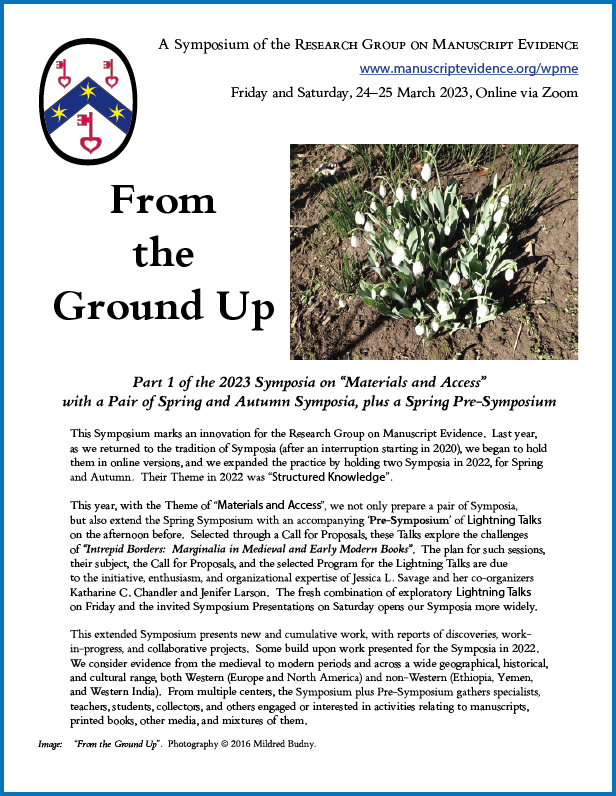
2023 Spring Pre-Symposium/Symposium Booklet Front Cover.
2022
“Structured Knowledge”
See our 2022 Spring and Autumn Symposia:
- “Structures of Knowledge” (Spring)
- “Supports for Knowledge” (Autumn)
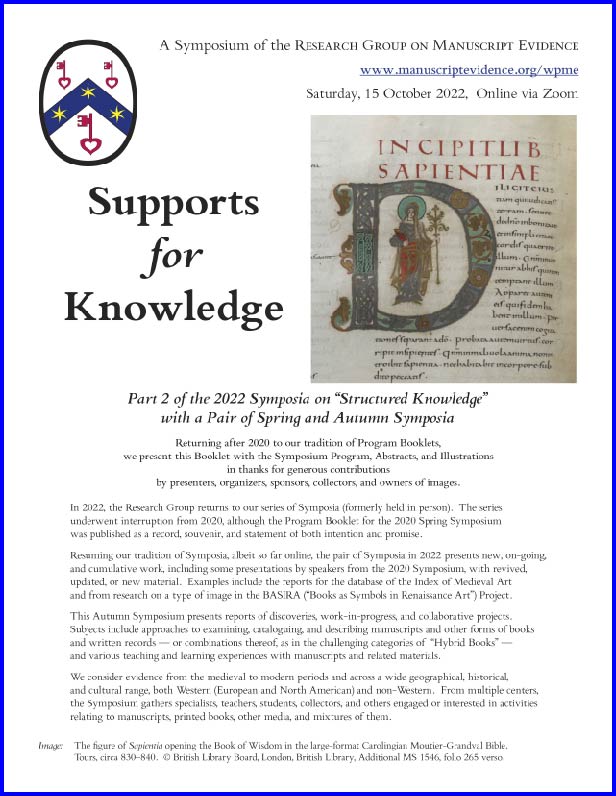
2022 Autumn Symposium Program Booklet, Front Cover (Page 1)
**********
Questions? Suggestions?
- Leave your comments or questions below
- Contact Us
Visit our Social Media:
- our FaceBook Page (https://www.facebook.com/people/Research-Group-on-Manuscript-Evidence/100064718795029/)
- our Facebook Group (https://www.facebook.com/groups/rgmemss/)
- our X/Twitter Feed (@rgme_mss)
- our Bluesky nest @rgmesocial.bluesky.social)
- our Instagram Page
- our LinkedIn Group
Join the Friends of the RGME.
Please make a Donation in Funds or in Kind for our nonprofit educational corporation powered principally by volunteers. Your donations and contributions are welcome, and can go a long way. They may be tax-deductible to the fullest extent provided by the law.
*****************
