
2026 International Congress on Medieval Studies: Program
February 1, 2026 in Announcements, Bāḥra ḥassāb: Knowledge Transmission in Ethiopia and Eritrea From Antiquity to Modern Times, Business Meeting, Conference, Conference Announcement, Event Registration, ICMS, International Congress on Medieval Studies, Kalamazoo, Koller-Collins Center for English Studies, Manuscript Studies, POMONA, Postal History at Kalamazoo, RGME Annual Appeal, RGME Library & Archives, Rossell Hope Robbins Library at the University of Rochester, Societas Magica
Program
Activities Sponsored and Co-Sponsored by the RGME
at the
61st International Congress on Medieval Studies
May 14–16, 2026
(Sessions variously online, in-person, and hybrid)
Sequence of RGME Activities at the 2026 Congress
[Posted on 15 January 2026, with updates]
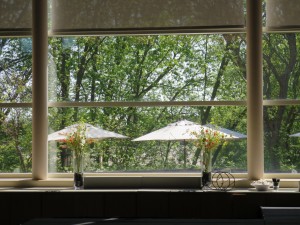
View from Fetzer Lounge at the 2017 Congress. Photography © Mildred Budny.
Here we list the Program of activities of the Research Group on Manuscript Evidence (RGME) at the 2026 International Congress on Medieval Studies (ICMS).
First we collaboratively designed a suite of Sessions (Panels of Papers) to sponsor or co-sponsor at this year’s Congress and, when they were accepted for the Congress, issued the Call for Papers:
The Program for the 2026 Congress appears on the Congress website.
With the completion of the Call for Papers, the selection of their proposals, the design of each session (with presider, sequence of papers, etc.), and the ICMS’s formation of the full Congress Program, we announce our Program of activities at the 2026 Congress (including sessions and our annual Open Business Meeting). We describe the activities one by one, now in the sequence in which they will occur.
The Program and information for the 2026 Congress appears on the Congress website.
To find our Sessions and Business Meeting there, search under Sponsoring Organization
Search for the RGME (or our Co-Sponsor for the given session). In the Sponsors’ list, you will find our sessions as a group:
The participation by the RGME at the Annual ICMS over the years is chronicled in our blog
Now we turn to the 2026 Congress and invite you to join our activities.

RGME Sessions for the 2026 ICMS
We announce five co-sponsored sessions for 2026.
The co-sponsors for our ICMS Sessions are:
- Societas Magica
- Polytheism-Oriented Medievalists of North America (P.-O.M.o.N.A.)
- Postal History at Kalamazoo
- Rossell Hope Robbins Library and Koller–Collins Center for English Studies at the University of Rochester
- Bāḥra ḥassāb: Knowledge Transmission in Ethiopia and Eritrea from Antiquity to Modern Times at the University of Münster
For our co-sponsorships for the Congress over the years, 2026 marks
Year 22 of our co-sponsorship with the Societas Magica
Year 5 with P.-O.M.o.N.A.
Year 3 with Postal History at Kalamazoo
Year 1 with Rossell Hope Robbins Library and Koller–Collins Center for English Studies at the University of Rochester
Year 1 with Bāḥra ḥassāb at the University of Münster
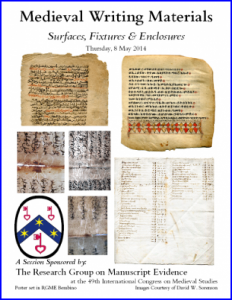
2014 Congress Medieval Writing Materials Poster
The Session co-sponsored with Postal History at Kalamazoo continues the tradition of our long-term series of RGME Sessions at the ICMS on “Medieval Writing Materials”, which began in 2014. See, for example,
- our Congress Activities over the years; and
- 2022 International Congress on Medieval Studies Program.
RGME Activities
Sessions and Open Business Meeting
Day 1. Thursday 14 May 2026
1. 10:30 am – 12:00 pm EDT (GMT-5)
RGME Session 1 = Congress Session 42
Moving the Mail: Letters, Couriers, and Post Offices in the Medieval World
In-Person Session
Sangren Hall 2130

Private Collection, Courier delivering letter. German translation of Petrarch (1559).
Co-sponsors
- Postal History at Kalamazoo
- Research Group on Manuscript Evidence
Organizers
* David W. Sorenson (Independent Scholar)
* Mildred Budny (Research Group on Manuscript Evidence)
Aim
In a world in which long-distance communication was necessarily through the written word, getting it from sender to recipient could be a complicated process. While important correspondence could be sent “post-haste,” ordinary letters were typically much less speedy, and while royal dispatches might go through an efficient royal system, ordinary mail received a very much less efficient, more ad hoc, treatment. This session is intended as a means of examining the means through which mail moved, whether in Europe or elsewhere.
Presider
* Ralph W. Mathiesen (University of Illinois at Urbana–Champaign)
Speakers
- * David W. Sorenson (Allen Berman, Numismatist)
“The Livery of Delivery:
Some Depictions of Letter-Carriers in Seventeenth- and Sixteenth-Century Paris” - * Eleanor A. Congdon (Youngstown State University)
“How Fifteenth-Century Italian Merchants Shared Information”
*****
Following this Session, we hold the 2026 Open Business Meeting. All are welcome to attend.
2. 12:00–1:30 pm EDT (GMT-4)
RGME Open Business Meeting
In Person Event (hybrid by arrangement with the RGME)
Student Center 2207
with Catered Lunch (provided by Donation)
For this Business Meeting, an online option to attend will be provided by the RGME, open to registrants of the Congress.
Registration
Please register for the Business Meeting. Whether you plan to attend in person or online, your registration will allow us:
- For IN PERSON Attendance
— to know numbers for the catering (and any dietary restrictions you wish to let us know about) and - For ONLINE Attendance (open to Congress registrants through a RGME-provided Zoom Meeting)
— to send you the RGME-Zoom Link ahead of time
Note:
For security, after you register to attend ONLINE, you would receive the Zoom Link a few days before the event by email from the RGME, not Eventbrite or Zoom.
To register, whether for IN PERSON or ONLINE participation, visit the RGME Eventbrite Collection:
- 2026 RGME Open Business Meeting at the ICMS
- 2026 Business Meeting IN PERSON
(with catered lunch)
2026 RGME Business Meeting IN PERSON: Registration
- 2026 Business Meeting ONLINE
2026 Open Business Meeting: Reservation
Like previous Annual Business Meetings, the Agenda and Annual Report will be circulated. For previous years, please see:
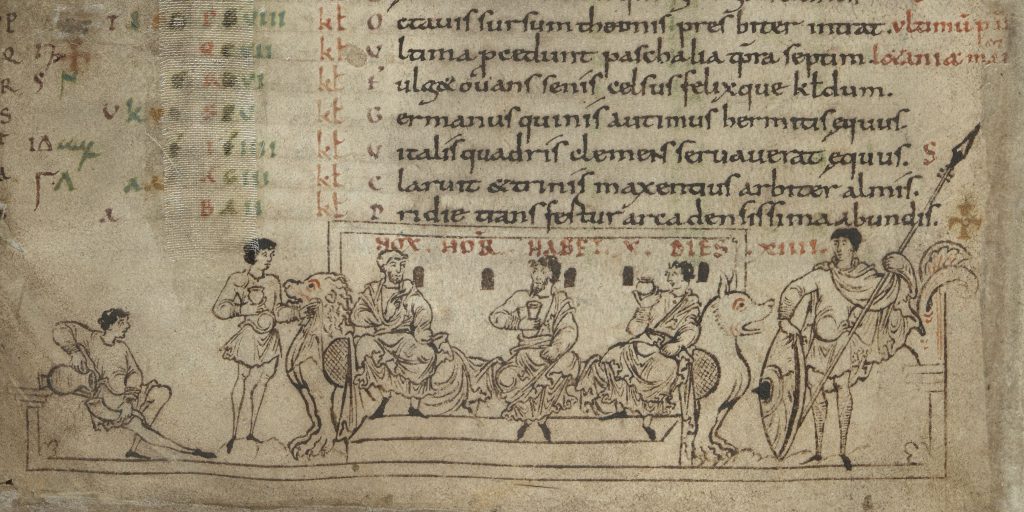
London, British Library, Cotton MS Julius A. VI, fol. 4v, detail.
*********
3. Magic, Manuscripts, and Material Culture
Congress Session 80
1:30–3:00 pm EDT (GMT-4)
Hybrid Session
Sangren 2730 (Hybrid)
Sponsors
- Research Group on Manuscript Evidence
- Rossell Hope Robbins Library and Koller–Collins Center for English Studies at the University of Rochester
- P-OMoNA (Polytheism-Oriented Medievalists of North America)
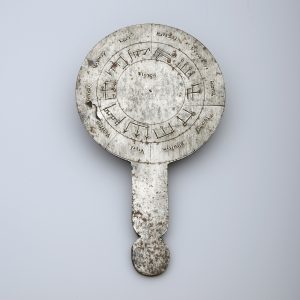
Magic mirror of Floron. Mathematisch-Physikalischer Salon, Staatliche Kunstsammlungen Dresden. Via Creative Commons.
Organizers
* Anna Siebach–Larsen (University of Rochester)
* Mildred Budny (Research Group on Manuscript Evidence)
* Phillip Bernhardt–House (Research Group on Manuscript Evidence)
* Derek Shank (Research Group on Manuscript Evidence)
Aim
Papers in this session will investigate the relationship(s) between manuscript descriptions of magical and/or alchemical rituals, implements, and other materials, the illustrations in those manuscripts, and archaeological evidence based on surviving artifacts. We will seek to further our understanding of how tools were used in physical rituals, as well as how practitioners procured, made, stored, used, and cared for the tools of their trade. We will also seek to understand where and how the evidence provided by worded descriptions, illustrations, and material artifacts corresponds with, conflicts with, or serves to mutually enrich the other evidence.
Presider
Anna Siebach–Larsen
Speakers
- Maryam Mirzaei (University of Art, Teheran)
“Factors Determining Occult Sciences:
Text–Image Signifiers in the Persian Manuscript of Zakhīri-i Iskandarī” - Phillip A. Bernhardt–House (Research Group on Manuscript Evidence)
“Three Kinds of Gentildecht in Medieval Ireland”
*****
Congress Day 2. Friday 15 May 2026
4. The Alchemy of Learning:
Magic, Pedagogy, and Public Engagement
Hybrid Session
Sangren 2730 (Hybrid)

Societas Magica logo
Co-sponsors
- Research Group on Manuscript Evidence
- Societas Magica
Organizer
Veronica Menaldi (Independent Scholar / Societas Magica)
Aim
In the middle ages astrology and other esoteric topics were part of the university curriculum. How is magic, in its most broad sense, taught or engaged with today and in what ways does it appear in both the classroom and public humanities outreach? Magic is an increasingly attractive topic for both students and the general public. As such, scholars, educators, and librarians/curators have vast opportunities to weave in clever methodologies to teach occult subjects from practical divination to collaborative compendiums. How can teaching magic jumpstart learning, increase engagement or interest, and propose solutions for perennial concerns among the occult-curious?
Presider
Veronica Menaldi
Speakers
- Ruthann E. Mowry (University of Illinois — Urbana–Champaign)
“Gateway to the Occult: Magic, Public Engagement, and Special Collections” - Angela Puca (Leeds Trinity University)
“From Inquisition Records to Public Humanities:
Teaching the Medieval Roots of Italian Witchcraft and Vernacular Healing” - Victoria Burns–Price (University of Oxford)
“Magic as a Pedagogical Crossroads”
*****
Congress Day 3. Saturday 16 May 2026
5. Chronology and Divination Beyond the Medieval West
Congress Session 286
Hybrid Session
Sangren Hall 1312 (hybrid)
Co-Sponsors
- Research Group on Manuscript Evidence
- Bāḥra ḥassāb: Knowledge Transmission in Ethiopia and Eritrea from Antiquity to Modern Times, at the University of Münster
Organizer
Augustine Dickinson (University of Münster)
Aim
While often considered categorically separate, it is typically the case in premodern manuscript cultures that no significant separation is made between chronology, astrology, and divination, with texts, tables, and diagrams related to these often appearing together in manuscripts. This phenomenon has drawn a meaningful amount of attention in research focused on the European and other intertwined manuscript traditions, but it continues to be overlooked with respect to traditions on the “periphery,” such as the Ethiopic, Syriac, Coptic, or Indic traditions. This session would bring together papers focused on these traditions while encouraging cross-disciplinary discussion with scholars working in other fields.
Presider
Mildred Budny (Director, Research Group on Manuscript Evidence)
Speakers
- Daria Elagina (University of Münster)
“Astrological Knowledge in Ethiopic Manuscript Culture:
Origins and Interconnections” - Augustine Dickinson (University of Münster)
“Magic and the Intellectual Tradition in Ethiopia”
Respondent
David Porreca (University of Waterloo)

Princeton University Library, Ethiopic Manuscript No. 42, fol. 47v. The Cycle of Kings (Awədä Nägäśət), Collection of Divination Texts. Image via https://dpul.princeton.edu/msstreasures/catalog/nc580r397.
*****
6. Grimoires of the Greater West: Conversations on Solomonic Magic
Congress Session 338
Hybrid Session
Sangren Hall 2730 (hybrid)
Societas Magica logo
Co-sponsors
- Societas Magica
- Research Group on Manuscript Evidence
Organizers
Gal Sofer (Ben-Gurion University of the Negev)
Matthew Melvin–Koushki (University of South Carolina–Columbia)
Aim
Solomonic magic is a transhistorical and transcultural phenomenon, with texts attributed to King Solomon appearing in Jewish, Christian, Islamic, and other traditions. While often studied in isolation, their shared vocabularies and interconnected histories remain understudied. This session takes a cross-cultural approach to Solomonic magic, inspired by recent publications like Solomonic Magic: Methodology, Texts, and Histories. We invite contributions that explore new sources or methodologies—from ritual manuals and talismanic compendia to demonological treatises and polemical texts—and encourage interdisciplinary dialogue to better understand the development and reception of these traditions.
Presider
Matthew Melvin–Koushki (University of South Carolina–Columbia)
Speakers
- Marla Segol (University of Buffalo)
“Sympathy or the Shock of the Strange?
The Magic of the Amniotic Sac in Medieval and Early-Modern Hebrew Grimoires” - Vajra Regan (Centre for Medieval Studies, University of Toronto)
“The Book on the Four Rings of Solomon
(Liber de quattuor anulis Salomonis):
Origins, Sources, and the Problem of Definining the ‘Solomonic Corpus’ “ - Gal Sofer (Ben-Gurion University of the Negev)
“From Circle to Marketplace:
The Early-Modern Career of the Solominic Pentacle” - Michael Edgar Rafael Folch (Queen’s University Kingston)
and Sharday C. Mosurinjohn (Queen’s University Kingston)
“Practicing Solomonic Magic Without Means or Mentor:
Improvisation and Trial in the Modern Age”
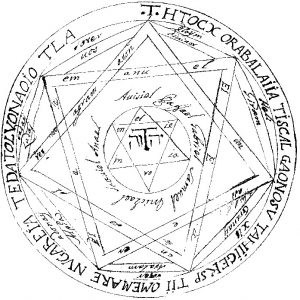
Diagram from Oxford, Bodleian Library Michael MS. 276, Clavicolo di Salomone Re d’Israel figlio de David, an Italian language version of the “Key of Solomon” grimoire —
a variant of the “Sigillum Aemeth” published in Athanasius Kircher’s Oedipus Aegyptiacus (Rome, 1652-4, pp. 479-81). Image Public Domain via https://commons.wikimedia.org/wiki/File:Aemethms.gif.
*****
Instructions
Don’t forget to register for the Congress. See its website for details.
*****

Wien, Österreichische Nationalbibliothek (ÖNB), Cod. 1224. Cutbercht Gospels. Salzburg circa 790. Portrait of the Evangelist Matthew at work on writing his text. Image via Image Public Domain via http://data.onb.ac.at/dtl/7365239.
Questions? Suggestions?
For questions about the individual sessions, please contact the organizers of the sessions or the RGME itself.
- Leave your comments or questions below
- Contact Us
- Sign up for our Newsletter and information about our activities.
Send a note to director@manuscriptevidence.org or RGMEevents@gmail.com
Visit our Social Media:
- our FaceBook Page
- our Facebook Group
- our Twitter Feed (@rgme_mss)
- our Bluesky nest @rgmesocial.bluesky.social)
- our LinkedIn Group
Join the Friends of the RGME.
Register for our Events by the RGME Eventbrite Collection.
Attend our next Events if your timetable allows.
Consider making a Donation in Funds or in Kind for our nonprofit educational corporation powered principally by volunteers. Your donations and contributions are welcome, and can go a long way. They may be tax-deductible to the fullest extent provided by the law.
Please consider remembering the RGME in your will! Might you like to present contributions to our Library & Archives, momentos of your experiences and aspirations, and funds to endow or encourage projects, mentoring, and the progress of our mission.
We look forward to hearing from you and welcoming you to our events.
*****
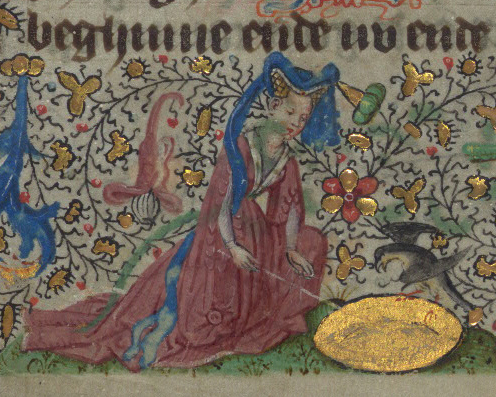
Baltimore, The Walters Art Museum, MS W.782, folio 15r. Van Alphen Hours. Dutch Book of Hours made for a female patron in the mid 15th century. Opening page of the Hours of the Virgin: “Here du salste opdoen mine lippen”. Image via Creative Commons. At the bottom of the bordered page, an elegantly dressed woman sits before a shiny bowl- or mirror-like object, in order, perhaps, to perform skrying or to lure a unicorn.
*****