A 13th-Century Pocket Vulgate Bible at Smith College
August 13, 2023 in Manuscript Studies
A Thirteenth-Century Pocket Vulgate Bible
at Smith College:
“The Dimock Bible”
(Mortimer Rare Book Collection MS 240)
Hannah Goeselt
RGME Guestblogger
[Posted on 30 October 2023]
Note: For this Blogpost, we welcome Guest Blogger, Hannah Goeselt, who reports on a manuscript which first caught her attention when examining manuscripts at Smith College in Northampton, Massachusetts, as part of her undergraduate studies. Now, having recently finished an MS at Simmons University in Library and Information Science (Cultural Heritage Informatics), she offers a guided tour to this book deserving wider attention and further research. We thank her for her contribution and invite you to join this guided tour.
As part of the tour, Hannah showcases the manuscript for its interest in its own right, and also, as she says, “to use it as an example of how one might go about using some of the online research tools out there to assist in manuscript studies”. Accordingly, she includes “everything from the De Ricci census, Conway–Davis directory, Schoenberg database, and Digital Scriptorium (with Smith’s own consortium database)”, as well as the Grolier Club, “which played an important part in assessing the content of the auction catalogs mentioned in Schoenberg”. Brava!
Over to you, Hannah . . .
Our Guest Manuscript:
Mortimer Rare Book Collection MS 240
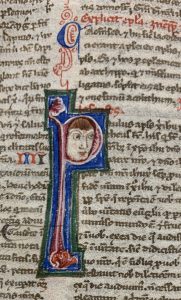
Smith College, MRBC MS 240, fol. 191v. Historiated initial for the Pauline Epistle to the Ephesians, with outward-looking male face. Photography by Hannah Goeselt.
While taking survey of material pertaining to manuscripts from Otto F. Ege (1888–1951) in collections across the campus of Smith College, I was drawn to this thirteenth-century Pocket Bible, with the pressmark “MRBC MS 240″, and thought it’d be worth initiating a sort of “meet-and-greet” with this codex. I have a fondness for 13th-century Latin Vulgate Bibles, often noted for their similarities and their contribution to forming our current concept of the Bible’s format. And yet within all that seemingly mass uniformity, on second glance they all contain their own unique qualities and histories.
At the Mortimer Rare Book Collection (MRBC) at Neilson Library, several jewels of medieval manuscripts among keep this book company, alongside a host of fragments. Notable examples are
- a large-scale Vulgate Bible written in a single column layout,
- a lovely mid-thirteenth-century French Psalter with early-modern devotional marginalia,
- a Book of Hours associated with Philip the Good, Duke Philip III of Burgundy (1306—1467, duke from 1419).
All three of these have featured on posts in Peter Kidd’s blog on Medieval Manuscripts Provenance:
- “A 13th-Century Bible from Beauvais at Smith College”
https://mssprovenance.blogspot.com/2014/12/a-13th-century-bible-from-beauvais-at.html - “A French 13th-Century Psalter at Smith College”
https://mssprovenance.blogspot.com/2015/07/a-french-13th-century-psalter-at-smith.html - “An Unrecognised Book of Hours Made for Philip the Good [Part I]”
https://mssprovenance.blogspot.com/2015/12/an-unrecognised-book-of-hours-made-for.html
They, along with many others, are available on the Digital Scriptorium website. However more recently the collections have also been added to the Five College Compass website, where MS 240 has joined them with a full digitization:
- https://compass.fivecolleges.edu/object/smith:1365930 (apart from its folio 1r, which I show here).
For users of the Smith College Libraries database (Students, Faculty, Staff, Community Borrowers), this is internal Permalink for the manuscript.
Let us, for the duration of this post, call it the Dimock Bible, as referred to in the Directory of Collections in the United States and Canada with Pre-1600 Manuscript Holdings (pages 52 and 62) by Melissa Conway and Lisa Fagin Davis, and due to the family name associated with its recent ownership. Within the library record, we see that the cataloger of this manuscript has done wonderful work in linking the manuscript to two very important sources that will help us in our search for more information.
Upon opening, we are met by the first page of the Bible text, which opens the preface to the bible unit itself by its translator Jerome (circa 342–347 – 420), who produced the Latin Vulgate Version. This image is omitted in the digital facsimile, though one can see a painted offset on the verso of the preceding leaf.
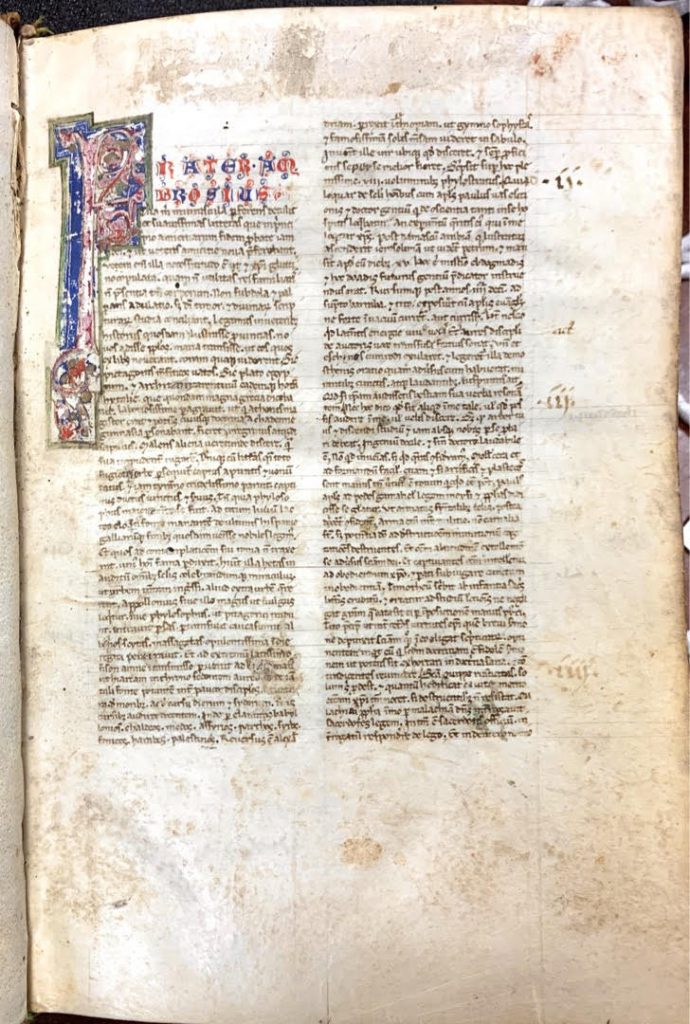
Smith College, MRBC MS 240, fol. 1r. Opening of Jerome’s preface ‘Frater Ambrosius’ for the bible unit. Photograph by Hannah Goeselt.