
Episode 22: “Encounters with Local Saints and Their Cults”
August 20, 2025 in Announcements, Event Registration, Manuscript Studies, Research Group Episodes for The Research Group Speaks, Research Group Speaks (The Series)
“The Research Group Speaks”
Episode 22
“Encounters with
Local Saints and Their Cults:
Traces in
Prose, Poetry, and Relics”
Saturday 13 December 2025
1:00–2:30 pm EST (GMT-5) by Zoom
[Posted on 20 August 2025, with updates]
For the series wherein “The Research Group Speaks,” we respond to suggestions and requests as the series unfolds. For information, please see:
For Episode 22 we turn to reports by several scholars working in different areas and language-groups upon a similar subject of perennial interest in religious, historical, and devotional identities. Presentations will be accompanied by responses, followed by opportunities for feedback and discussion.
This Episode considers the characteristics of veneration of local saints, as manifested in the surviving evidence, especially in manuscripts. Among the materials are vitae, hymns and liturgical practices for saints’ feast days. The nature of the subject, as well as research work and discoveries in a variety of fields, shows that this episode offers scope for follow-up in one or more episodes in our series.
Speakers and Respondents
- Guesh Solomon Teklu (Hiob Ludolf Centre for Ethiopian & Eritrean Studies, University of Hamburg)
- Augustine Dickinson (University of Münster)
- Mersha Alehegne Mengistie (Addis Ababa University; University of Hamburg)
- Antony R. Henk (Ruhr-University Bochum)
Presider
- Renate Blumenfeld–Kosinski (Renate Blumenfeld–Kosinski)
Outline
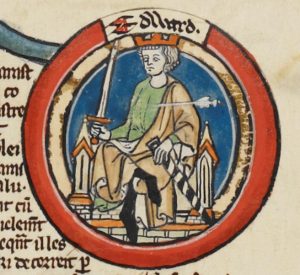
London, British Library, MS Royal 14 B VI, detail. King Edward Martyr, Image Public Domain via Wikimedia Commons via https://upload.wikimedia.org/wikipedia/commons/e/e3/Edward_the_Martyr_-_MS_Royal_14_B_VI.jpg.
This episode aims to consider the challenges and opportunities when encountering and studying local saints, those whose renown and veneration might not have reached a wide audience or enjoyed a persistent duration. Nonetheless, their stories and the individuals or communities who both followed and cultivated their appeal can reach across time and place to show how the habits of pious practices and the methodologies for discovering materials and contexts in modern study might be shared in widely different cultures, languages, and periods.
Looking at case studies from complete vitae, where the saint’s biography is given in full but only circulated locally, and progressing to hymns and paracontent, where only names and scattered biographic hints survive, the speakers and respondents will reflect on the methodological challenges posed in each instance and strategies for engaging with them.
Among the subjects will be Ethiopic vitae and hymns and Western Medieval liturgical Kalendars (such as in Books of Hours in Latin and/or vernaculars). Evidence includes manuscripts, printed sources, and textiles.
Program
1. Presentations
Guesh Solomon Teklu
(Hiob Ludolf Centre for Ethiopian & Eritrean Studies, University of Hamburg)
“The Gadla ʾAbbā Tansʾa Wald of Dabra Gʷǝlgizā and His Disciple Monks:
Thematic Aspects of Salāmtā Poetic Texts”
The Dabra Gʷǝlgizā (also known as Ǧǝwamāra) monastic tradition, founded by ʾAbbā Tansʾa Wald, represents a significant network of local and Egyptian saints and monasteries centered in Qollā Tamben, ʿĀdet, and Ṣallamṭi areas in Tigray, Ethiopia. The Gadla ʾAḫbǝro (literally ‘Combined vitae’) is a hagiographic compilation that chronicles the lives of ʾAbbā Tansʾa Wald and his disciple monks. The text mainly narrates the life of ʾAbbā Tansʾa Wald’s and the deputy abbot of ʾAbbā Maʿāza Dǝngǝl. The other fellow monks, ʾAbbā Tādewos of Dabra Maṣḥet ʿAbizāqa, ʾAbbā Tansʾa Krǝstos of Dabra Gannat, ʾAbbā Giyorgis of Kāwe, ʾAbbā Tomās of Ṣallay, ʾAbbā Zarʿā Bǝruk of ʾƎkkǝma, and ʾAbbā Fiqiṭor of Qaṣabā are mentioned several times throughout the hagiography. These monks lived and served together at Dabra Gʷǝlgizā in Qollā Tamben during the thirteenth to fourteenth centuries, according Gadla ʾAḫbǝro manuscripts.
This communal monastic life is extensively documented throughout the Gadla ʾAḫbǝro codices and the individual hagiographic texts of each saint. Following the death of the abbot, ʾAbbā Tansʾa Wald, his disciples established their own monastic churches, creating an interconnected network of religious foundations. The exception was ʾAbbā Maʿāza Dǝngǝl, who succeeded him as abbot at Dabra Gʷǝlgizā. Some remained in Qollā Tamben itself (ʾAbbā ʾAbbā Tomās, and ʾAbbā Zarʿā Bǝruk), while others founded monasteries in adjacent districts surrounding the Tekeze River, including ʿĀdet (ʾAbbā Giyorgis and ʾAbbā Fiqitor) and the Ṣallamṭi areas (ʾAbbā Tādewos and ʾAbbā Tansʾa Krǝstos). This presentation examines the religious, political, and environmental themes addressed in three hagiographies from this networked monastic tradition: the Gadla ʾAḫbǝro, the Gadla ʾAbbā Tādewos, and the Gadla ʾAbbā Tansʾa Krǝstos. Special emphasis is given to the thematic aspects of the salāmtā (ʾarke) poetic texts across these hagiographies.
Augustine Dickinson
(University of Münster)
“Identifying Ethiopic Hymns for Local Saints in Anthology Manuscripts”
When working with manuscript anthologies or collections of malkǝʾ-hymns, it is most often the case that the saints whose hymns are included are well-known and easily identified, whether they are saints known across Christian traditions or saints proper to the Ethiopian/Eritrean context. This paper will present case studies where the subject of a hymn is not so easily identified, always monastic saints commemorated only by a single monastery or within a relatively small network. Each case study will highlight strategies for finding clues leading to identifications (whether tentative or confident) of their respective subjects and contribute to broader remarks on this phenomenon in the field of Ethiopic hymnography.
2. Responses
Mersha Alehegne Mengistie
(Associate Professor, Department of Linguistics and Philology, Addis Ababa University)
“Experiences with and Discoveries for Local Hagiography in Ethiopia
and Their Implications for Publication”
Mersha will describe experiences with and discoveries for local hagiography in Ethiopia broadly and their implications for publication.
Antony R. Henk
(Ruhr-University Bochum)
“Inventing Peter the Deacon as Saint in Early England:
Mistaken Identity or Made up Entirely?”
Medieval English relic lists offer tantalizing clues to the presence of many now-obscure saints. One striking example is the presence of a later annotation in the late eleventh-century Exeter relic list in British Library, Royal MS 6 B VII, which explains that the relics of saint ‘Petri diaconi’ (Peter the Deacon) in that particular version of the list are, in fact, the relics of the ‘discipuli gregorii papae’ — the student of pope Gregory the Great, not the fourth-century Antiochene martyr by the same name commonly venerated in early England.
The English church’s deep affection for Gregory the Great is well understood, and his relics and feasts are widely attested in the English manuscript corpus. However, little evidence suggests that his companion and interlocutor in the Dialogi ever achieved lasting cult status in England, aside from a single embroidered depiction of a nimbed Peter on the early tenth-century maniple found with the body of Saint Cuthbert, still today an object of adoration at Durham Cathedral. In this short response, I ask a fateful question: Did the English Church try to ‘invent’ a Cult of Peter the Deacon, and what could the evidence here tell us about cases of seemingly mistaken sanctoral identity?
Note: For an image and bibliography about the textile image of Peter the Deacon as saint in the maniple among the Cuthbert embroideries see this site.
Antony Henk’s Handout:
3. Q&A
There follows the opportunity for questions, comments, and discussion. We welcome your observations.

Manuscript still in situ. Fols. 14v-15r. The beginning of Malkəʾa Marqorewos (Image of Marqorewos), a local saint of the monastery Ṣaʿadā ʾƎmbā ʾƎndā ʾAbuna Marʿāwe Krǝstos, within an anthology (malkǝʾa gubāʾe) manuscript. Photograph by Michael Gervers. Image via https://malkeagubae.com/manuscripts/MK049/#unit1item3.
Registration
Within the RGME Eventbrite Collection:
Registration is free. We encourage you to Pay What You Can with the option for a Voluntary Donation. This year, the RGME has undergone setbacks with grants and funding, so that we ask your help. Any amount will give encouragement and contribute to recovering momentum. We thank you for your support.

Trier, Stadtbibliothek, MS. 171/1626: “Gregory Leaf”. Behind a curtain, Peter the Deacon witnesses Gregory the Great at work inspired by the Holy Spirit in the form of a dove. Master of the Registrum Gregorii, Image Public domain, via Wikimedia Commons.
Donations, which may be tax-deductible, help us to continue with our activities and sustain our mission for an organization principally powered by volunteers.
Please note:
- After your registration, the RGME will send you the Zoom Link as an email directly a few days before the event
- For security reasons, we do not distribute tickets or links through Eventbrite or Zoom.
If you have questions or problems with registering, or accessing the link,
- Contact the RGME, not Eventbrite or Zoom,
via rgmesocial@gmail.com
We use these measures to protect the security of our events.
Thank you for your interest in this event.
*****
Next Episode

Bembino Swash Motif
For our next Episode, see
- Episode 23. Meet RGME Bembino: Facets of a Font
Saturday 21 February 2026 at 1:00-2:30 pm EST (GMT-5) by Zoom
Registration
*****
Questions? Suggestions?
- Leave your comments or questions below
- Contact Us
Visit our Social Media:
- our FaceBook Page (https://www.facebook.com/people/Research-Group-on-Manuscript-Evidence/100064718795029/)
- our Facebook Group (https://www.facebook.com/groups/rgmemss/)
- our X/Twitter Feed (@rgme_mss)
- our Bluesky nest @rgmesocial.bluesky.social)
- our Instagram Page
- our LinkedIn Group
Join the Friends of the RGME.
Please make a Donation in Funds or in Kind for our nonprofit educational corporation powered principally by volunteers. Your donations and contributions are welcome, and can go a long way. They may be tax-deductible to the fullest extent provided by the law.
*****
Is it okay to participate in this workshop?
Yes, you could register for this workshop. There is no charge to register. Please use the RGME Eventbrite Registration Portal (link in the blogpost). We look forward to welcoming you.